How to Rig a Line for Snake River Sturgeon
Trying to land one of Idaho's legendary White Sturgeon on the Snake River can feel like trying to wrestle a freight train from the depths. Their sheer size and incredible power mean that a flimsy setup or an improperly tied rig isn't just a minor setback – it's an almost guaranteed way to lose a fish, bust your gear, and leave you with nothing but a story of "the one that got away." This guide is designed to cut through the confusion and frustration, giving you a detailed, step-by-step breakdown of how to rig your line for Snake River sturgeon, ensuring you're truly prepared for an epic battle and, hopefully, a memorable catch and release.
Understanding the Legendary Snake River White Sturgeon
Before we even talk about hooks and weights, it's crucial to understand the magnificent fish you're targeting. White Sturgeon are the largest freshwater fish in North America, and the Snake River is home to some truly colossal specimens. These aren't your average trout; they're ancient, powerful, and demand respect – both in your gear choice and your fishing technique.
The Sheer Scale and Power of Sturgeon
Imagine reeling in a fish that can easily be six, eight, or even ten feet long, weighing hundreds of pounds. The largest White Sturgeon caught in Idaho weighed over 675 pounds and measured nearly eleven feet! That kind of raw power means they can snap light lines, bend weak hooks, and spool reels in a matter of seconds. When a large sturgeon decides to run, it's like hooking into a moving boulder. You need a rig that can withstand immense pressure and prolonged fights. Anglers often underestimate the sheer scale of these fish, only to find their equipment completely outmatched. If you're wondering How Big Do White Sturgeon Get in the Snake River, the answer is: truly immense.
Protected Status and Catch-and-Release Only
It's vital to remember that all White Sturgeon fishing on the Snake River is strictly catch-and-release only. This isn't just a suggestion; it's a critical regulation designed to protect these incredible, long-lived creatures. Improper handling, incorrect rigging, or cheap, damaging gear can severely injure a sturgeon, jeopardizing its survival. Because of this, everything from your hook choice to your fighting technique needs to prioritize the fish's well-being. This is why understanding Why Snake River Sturgeon Fishing Is Catch and Release Only is paramount to any successful trip.
Assembling Your Arsenal: Essential Gear for Sturgeon Fishing
To effectively rig for Snake River sturgeon, you need heavy-duty gear that can handle the stress. This isn't the time to skimp or bring your bass fishing setup. Think big, strong, and durable.
Rods and Reels Built for Battle
For rods, you're looking for something with a heavy power rating and a moderate-fast action, typically 7 to 9 feet in length. Specialized sturgeon rods are ideal, but a sturdy saltwater rod designed for big game can also work. The rod needs to have enough backbone to absorb powerful runs and lift a heavy fish from the bottom.
When it comes to reels, conventional baitcasting reels are generally preferred over spinning reels due to their superior drag systems and line capacity. You'll want a reel capable of holding at least 250-300 yards of heavy braided line, with a smooth, reliable drag system that can be cranked down when needed. Brands like Penn, Daiwa, or Shimano offer excellent options for this kind of heavy fishing. You can often find great deals on these robust reels on sites like Amazon.
Line Strength and Material Choices
Your main line is arguably the most critical component. Braided line is the overwhelming choice for sturgeon fishing, and for good reason. It offers incredible strength-to-diameter ratio, minimal stretch for solid hooksets, and excellent abrasion resistance. You'll want to spool your reel with 80 to 120-pound test braided line. Anything less, and you risk getting spooled by a truly large fish or snapping off on a powerful run. For your leader, 80 to 150-pound test monofilament or fluorocarbon is commonly used. While fluorocarbon is more abrasion resistant and virtually invisible underwater, monofilament is more affordable and has a bit more stretch, which can act as a shock absorber.
Hooks, Weights, and Swivels: The Business End
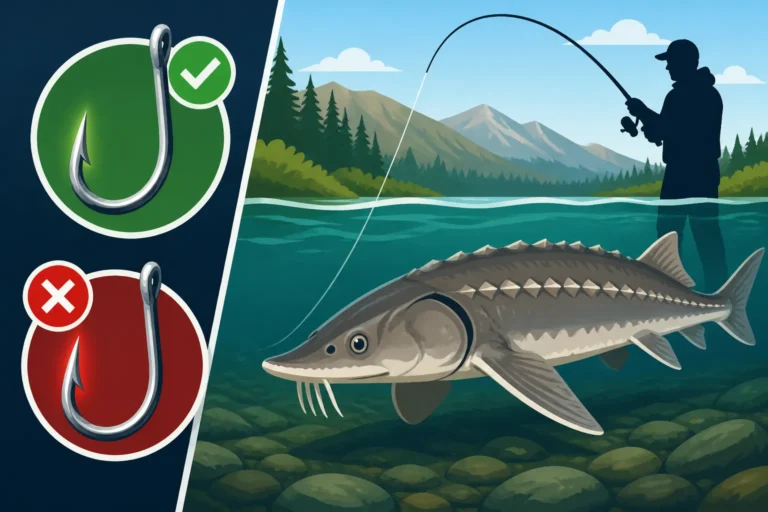
This is where your rigging truly comes into play. For hooks, only use stout, barbless circle hooks. The barbless requirement is non-negotiable for sturgeon conservation, as detailed in What Barbless Hooks Do for Sturgeon Survival. Circle hooks are also crucial because they are designed to hook fish in the corner of the mouth, minimizing deep hooking and making release easier. Sizes typically range from 7/0 to 12/0, depending on your bait size.
For weights, you'll need pyramid or flat-bottomed weights ranging from 8 ounces up to 24 ounces, or even heavier in swift current. The goal is to hold your bait firmly on the bottom without drifting. Swivels should be heavy-duty ball-bearing swivels rated for at least 200 pounds to prevent line twist and ensure all connections are strong. Snap swivels are handy for quickly changing weights.
Here's a quick checklist of essential gear:
| Component | Recommendation | Typical Specs |
|---|---|---|
| Rod | Heavy Power, Moderate-Fast Action | 7-9 ft specialized sturgeon or saltwater |
| Reel | Conventional Baitcaster, High Drag | Holds 250-300+ yds 80-120lb braid |
| Main Line | Braided Line | 80-120 lb test |
| Leader | Monofilament or Fluorocarbon | 80-150 lb test |
| Hooks | Barbless Circle Hooks | 7/0 – 12/0 |
| Weights | Pyramid or Flat-bottomed | 8 – 24+ oz (depending on current) |
| Swivels | Heavy-Duty Ball Bearing | 200 lb rated |
| Pliers/Cutters | Heavy-duty, for hooks and line | |
| Gloves | Grippy, protective | For handling line and fish |
| Landing Net | Large, sturgeon-specific (if allowed/used) | Net with rubberized mesh for fish safety |
The Art of the Rig: Step-by-Step Setup for Snake River Sturgeon
Now, let's get down to the actual rigging. The most common and effective rig for Snake River sturgeon is a variation of the sliding sinker rig. This setup allows the fish to pick up the bait and move off without immediately feeling the weight of the sinker, leading to more confident bites.
The Basic Sliding Sinker Rig
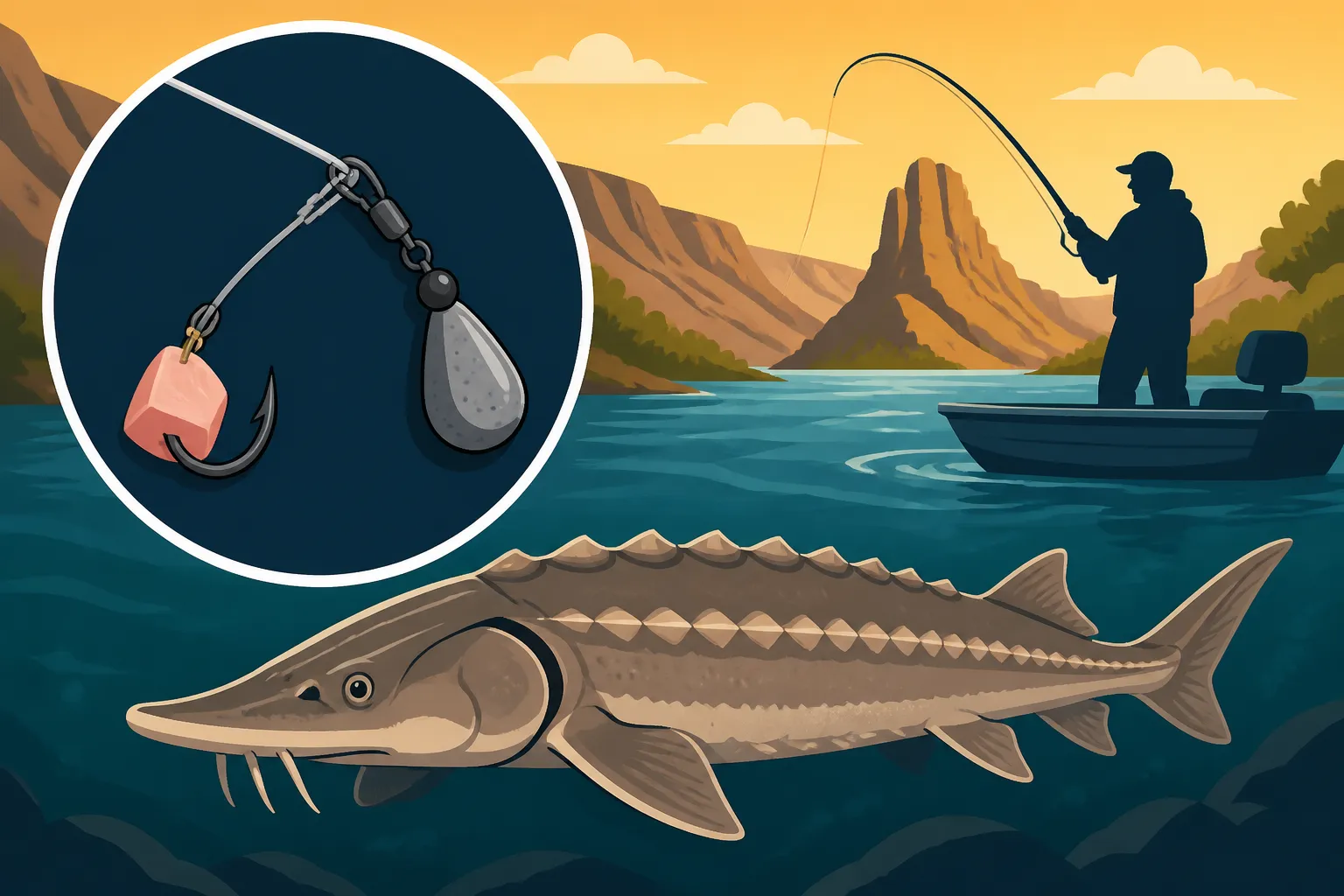
The sliding sinker rig is relatively simple, but each component plays a critical role. It consists of your main line, a sliding weight, a bead, a heavy-duty swivel, and a leader with a single barbless circle hook. The beauty of this rig is its effectiveness in presenting bait naturally on the bottom while giving the sturgeon a chance to "mouth" the bait before feeling resistance.
To begin, you'll thread your chosen heavy weight onto your main braided line. This should be a weight appropriate for the current conditions of the Snake River where you are fishing. After the weight, slide on a sturdy bead. This bead acts as a buffer, protecting the knot that will secure your main line to your swivel from the abrasive action of the sliding weight during casting and fighting.
Next, tie your main line directly to one end of a heavy-duty ball-bearing swivel using a strong knot like a Palomar knot or a uni-knot. Double-check your knot security! This connection is vital, as it's the anchor point between your main line and your leader.
Attaching the Leader and Hook
Now, it’s time to prepare your leader. Your leader should be made of 80 to 150-pound monofilament or fluorocarbon, and typically around 18 to 36 inches long. The length can vary based on personal preference and current conditions; a longer leader allows the bait to waft more naturally in the current, while a shorter one keeps it closer to the weight.
Tie your chosen barbless circle hook (7/0 to 12/0) to one end of your leader. Again, a Palomar knot or snell knot works well here. Make absolutely certain it’s a barbless hook – this is an important part of Idaho Fishing Regulations Explained for sturgeon, and crucial for the fish's survival. Then, tie the other end of your leader to the remaining open eye of your heavy-duty swivel. This completes your sliding sinker rig. When shopping for these components, especially specific hook and swivel sizes, Amazon can be a reliable source.
Presenting Your Bait: Techniques for Success
Once your line is rigged, the next critical step is baiting up and getting it into the prime sturgeon territory. The Snake River offers diverse habitats, and understanding where to place your bait is just as important as the bait itself.
Choosing and Preparing Your Bait
Sturgeon are primarily scavengers, relying heavily on their acute sense of smell to locate food. Therefore, fresh, oily, and pungent baits are typically the most effective. The most popular choices on the Snake River include cut bait from oily fish like shad, herring, or mackerel, especially when it's been allowed to "ripen" slightly to enhance its scent. Other effective baits include nightcrawlers (often in a large ball), clam necks, or even shrimp.
When baiting your circle hook, ensure the hook point and barb (or where the barb would be) remain exposed. This is crucial for the circle hook to work as intended, pivoting and catching in the corner of the sturgeon's mouth as it mouths the bait and moves off. Don't "hide" the hook too much within the bait. For a deep dive into options, check out Best Bait for Idaho Sturgeon Fishing.
Casting and Anchoring Your Bait
After baiting, it's time to cast. With heavy weights and large baits, a powerful overhead cast or a sidearm cast (if you have room) is usually necessary. Aim for deep holes, current seams, or areas downstream of structure where sturgeon are likely to be resting and feeding. Once your rig hits the water, let it sink directly to the bottom.
It's critical that your weight anchors firmly. If your line is constantly drifting, your bait isn't staying put, and you're not fishing effectively. Adjust your weight as necessary to ensure it holds. Once your bait is set, engage your reel, but back off your drag slightly or use a bait clicker. This allows a sturgeon to take the bait without immediately feeling resistance, which is vital for them to fully commit.
Handling the Giant: Fighting and Release Protocols
Landing a sturgeon is a test of endurance, both for you and your gear. And remember, the job isn't done until the fish is safely released.
The Fight of Your Life
When a sturgeon bites, it's usually not a subtle tap. Your rod tip will often start twitching or slowly bend over. Let the fish take the bait for a few seconds, ensuring it has it fully in its mouth. Then, slowly and firmly lift your rod, reeling tight as you do to set the hook. Do not jerk hard like you would with a bass; the circle hook will do its job with steady pressure.
Once hooked, prepare for a long, powerful fight. Keep your rod tip up, maintain steady pressure, and let the drag do its work. Resist the urge to crank down your drag too tight, as this can snap your line, bend your hook, or pull the hook free. Sturgeon often make powerful runs, even peeling off hundreds of yards of line. Let them run, then slowly gain line back when they pause. Pumping the rod (lifting and reeling down) is an effective way to bring them in. Getting a sense of How Long It Takes to Land a Sturgeon in Idaho can help manage your expectations.
Safe Handling and Release
Bringing a sturgeon to shore or boat-side requires careful attention to its well-being. Once it's close, minimize the fight. Do not remove the fish from the water. This is a crucial regulation in Idaho, as emphasized in Idaho Rule Against Removing Sturgeon from the Water. Their internal organs are not designed to support their immense weight out of water, and it can cause severe injury or death.
Unhook the fish while it's still in the water. Use long-nosed pliers to gently remove the barbless circle hook from the corner of its mouth. If the hook is stubborn, you can try to cut the leader as close to the hook as possible. Once unhooked, hold the fish gently by the tail or head if needed, allowing it to regain its strength before letting it swim away on its own. Ensure it's revived and swimming strongly before releasing your hold. For more details, consult How to Release a Sturgeon Safely in Idaho. Learning How to Fight a Sturgeon on the Snake River properly is key to minimizing stress on the fish.
Final Thoughts on Your Sturgeon Rigging Adventure
Rigging a line for Snake River sturgeon is about more than just tying knots; it's about respecting an ancient species and preparing for a true angling challenge. By using the right heavy-duty gear, meticulously setting up your sliding sinker rig with barbless circle hooks, and employing careful baiting and presentation, you're not just increasing your chances of success, you're also ensuring the health and future of these incredible fish. Good luck out there, and may your drag sing a triumphant tune!
Disclaimer
Please note that fishing regulations, including those for sturgeon, can change. Always consult the latest Idaho Fish and Game regulations before heading out on your fishing trip to ensure compliance. This guide is for informational purposes only and does not replace official state regulations.