How to Fill Out an Idaho Steelhead Catch Record Card
Alright, fellow anglers, let's talk about something that might not be as thrilling as a screaming reel but is absolutely critical for anyone chasing those magnificent steelhead here in Idaho: the Catch Record Card. It’s easy to feel a little intimidated by official paperwork, especially when all you want to do is focus on the tug on your line, but this little card is a big deal. For many, it feels like just another hurdle, a tedious task after a long day on the water, but I promise, understanding and correctly filling out your Idaho Steelhead Catch Record Card is simpler than you think and incredibly important. This guide is going to walk you through every single step, dispelling any confusion so you can fish with confidence and be a responsible steward of our incredible steelhead fisheries.
Understanding the Importance of Your Steelhead Catch Record Card
Before we dive into the nitty-gritty of ink and boxes, let’s chat for a moment about why this card exists in the first place. It's not just bureaucratic red tape designed to annoy you. Far from it, actually. This card is a vital piece of the puzzle for managing Idaho's treasured steelhead runs, ensuring these incredible fish continue to thrive for generations to come.
Why This Little Card Matters So Much
Think of your Catch Record Card as a direct line of communication between you, the angler, and the Idaho Department of Fish and Game. Every time you head out with your Idaho Steelhead Permit, you're participating in a grand experiment, and your observations (and harvests) are crucial data points. When you accurately record your catch and effort, you're providing Idaho Fish and Game biologists with real-time, real-world information. They use this data to understand how many steelhead are being caught, where they're being caught, and how much effort anglers are putting in.
This information directly influences future fishing seasons, catch limits, and conservation strategies. For instance, if data shows a particular run is struggling, they might adjust bag limits or even close a section of a river temporarily to protect the fish. Conversely, if a run is strong, they might be able to offer more generous harvest opportunities. Without accurate reporting from anglers like us, these crucial management decisions would be made with less complete information, potentially jeopardizing the very fisheries we love to explore. It's a fundamental part of the Idaho Fishing Regulations Explained and a responsibility we all share.
The Consequences of Incorrect or Missing Information
Ignoring your Catch Record Card or filling it out incorrectly isn't just a minor oversight; it can have real repercussions, both for you and for the steelhead population. First and foremost, failing to return your card, or returning it incomplete or inaccurate, can result in penalties. We're talking about fines, and in some cases, even the loss of your fishing privileges. No one wants that to happen, especially when you're just out to enjoy the water.
Beyond the personal legal ramifications, the bigger picture is the impact on the fishery itself. If thousands of anglers don't report their catches, or report them incorrectly, the data becomes skewed. This makes it incredibly difficult for biologists to get an accurate picture of the steelhead population. Imagine trying to manage a business without knowing how much product you're selling or how much inventory you have – it would be a disaster! The same goes for fish management. If harvest numbers are underestimated, it could lead to overfishing, putting a strain on sensitive wild steelhead populations. Conversely, if effort isn't recorded, it's harder to gauge angler participation and success rates, which also informs management decisions. So, while it might feel like a small piece of paper, its impact is truly significant. It’s part of the broader Idaho Fishing License Guide requirements.
Getting Started: What You Need Before You Fill It Out
Before you even think about putting pen to paper (or finger to screen, if you're reporting online), it's important to gather a few key items and understand where your Catch Record Card actually lives. A little preparation goes a long way in making this process smooth and stress-free.
Essential Information to Have Handy
When it comes time to complete your Catch Record Card, whether you're doing it immediately after a successful day on the river or sitting down at home, you'll want to have certain pieces of information readily available. This includes:
- Your Idaho Fishing License: This might seem obvious, but you'll need your exact license number.
- Your Idaho Steelhead Permit: Just like your general license, the permit number is often required. Remember, you typically need both to fish for steelhead.
- A Reliable Pen: And I mean reliable! Something waterproof or at least smudge-proof is ideal, especially if you're out on the water. A good quality waterproof pen is something I always keep in my tackle box; you can even find multi-packs on Amazon that hold up well to outdoor conditions.
- A Calendar or Date Reference: You'll be recording specific dates of your fishing trips and catches.
- Location Specifics: Knowing which river section you were on (e.g., "Clearwater River – Lower Section" or "Salmon River – Riggins Area") is important.
- Knowledge of Hatchery vs. Wild Steelhead: This is crucial. You absolutely must be able to How to Identify a Hatchery Steelhead versus How to Identify a Wild Steelhead. Hatchery steelhead typically have a clipped adipose fin, while wild steelhead do not. Retention rules are very different for these two categories.
Having all this ready means you won't be scrambling, especially if you're trying to recall details weeks later.
Locating Your Catch Record Card
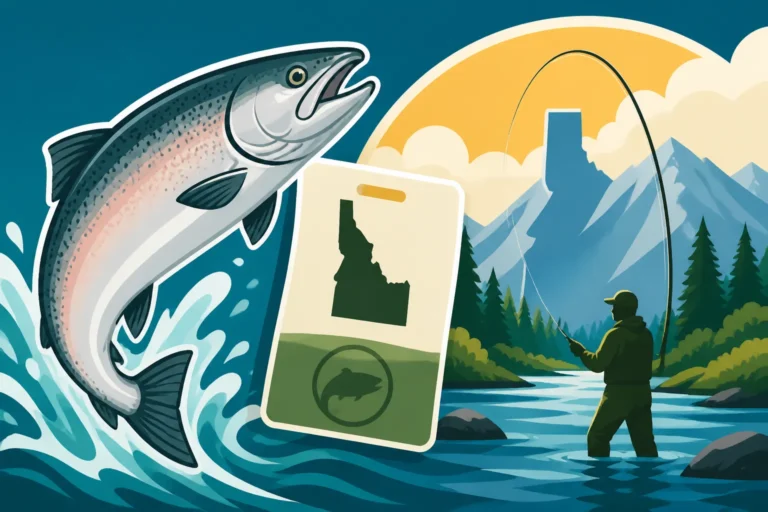
So, where exactly do you find this elusive card? For many Idaho anglers, the steelhead Catch Record Card is integrated directly into your annual fishing license. When you purchase your Idaho Resident Annual Fishing License or Idaho Nonresident Annual Fishing License and add the steelhead permit, the card is often printed right on the back of your physical license document or as a separate tear-off section.
If you purchase your license online through the Idaho Department of Fish and Game website (check out How to Buy an Idaho Fishing License Online for details), you'll often print a temporary license with the card included, and then receive a more durable version in the mail. Keep that initial printout safe! It's always a good idea to make a photocopy or take a clear photo of your blank card before you start using it, just in case you lose the original. Better yet, tuck it into a clear, waterproof sleeve that you can also find on Amazon. This protects it from the elements and wear and tear throughout the season. Sometimes, depending on the year or specific permit, it might be a completely separate small card. Always double-check what you receive when you get your Idaho Fishing License Cost Guide sorted and your permits in hand.
Step-by-Step Guide to Filling Out Your Catch Record Card
Okay, deep breath. We're going to break down the actual act of filling out the card into manageable steps. This isn't rocket science, but accuracy and attention to detail are your best friends here.
Section 1: Personal Information and License Details
The very first part of your Catch Record Card will typically ask for your basic identification and license information. This is pretty straightforward but don't rush through it.
- Name and Address: Print clearly. This ensures the card can be matched to you.
- Customer ID/Hunter & Angler ID: This is a unique number assigned to you by Idaho Fish and Game. It's usually found on your fishing license.
- Fishing License Number: Locate the primary fishing license number on your card and write it in the designated space.
- Steelhead Permit Number: Your specific Idaho Steelhead Permit will have its own unique number. Make sure to enter this accurately.
- Dates: Your card will likely have spaces for the effective dates of your license and permit. This is usually pre-printed or straightforward to copy from your license.
Think of this section as your personal header. It tells Fish and Game who is submitting the data. Double-check every number before moving on. A small transcription error here can make your entire card difficult to process later.
Section 2: Recording Your Steelhead Harvest
This is the core of the Catch Record Card. It’s where you document your actual encounters with steelhead. The card is designed to record both kept (harvested) fish and released fish, though the focus for mandatory reporting is often on harvested fish that contribute to the bag limit.
Let’s imagine you're out on the Clearwater River, feeling that incredible surge as a steelhead takes your lure. You fight it, land it, and realize it's a hatchery fish (clipped adipose fin), within the legal size and bag limit. Here’s what you need to do:
- Date of Catch: Immediately after deciding to keep the fish, record the exact date you caught it.
- River/Area: Note the specific river or general area where the catch occurred (e.g., "Clearwater River," "Salmon River near Riggins").
- Hatchery (H) or Wild (W): This is paramount. Look for the adipose fin. If it's clipped, it's a hatchery fish (mark "H"). If it's intact, it's a wild fish (mark "W"). Remember, in most Idaho waters, wild steelhead must be immediately released unharmed. You are generally only allowed to harvest hatchery steelhead. Check the latest Idaho Hatchery vs Wild Steelhead Rules and Idaho Fishing Regulations Explained for specifics on the water you are fishing.
- Marking Your Harvest: This is the most crucial part for kept fish. The card will have a series of boxes or circles, often numbered, corresponding to your daily and seasonal bag limits. Immediately upon keeping a legal hatchery steelhead, you must validate your catch by marking off the corresponding box or punching out the designated circle. For instance, if your daily limit is 1 hatchery steelhead and you keep one, you mark off the first box. If your seasonal limit allows for more, you’d mark the next box on subsequent kept fish. This act of marking is irreversible and signifies that this fish counts towards your limit. Do not delay this step! It's legally required to be marked immediately. Failing to do so could be seen as possessing an illegal fish.
What about released fish? Many cards also offer a space to record released fish, sometimes with separate columns for hatchery and wild releases. While often not mandatory to report immediately, it's excellent practice to keep track of these as well. It provides valuable data on effort and fish encounters, even if no fish are harvested. Some anglers keep a small notepad or even use a fishing app on their phone for released fish, then transfer that info later.
Here’s a simplified table illustrating the marking process for a hypothetical scenario (always refer to your specific card for exact layout):
| Date of Catch | River/Area | Hatchery (H) / Wild (W) | Mark 1st Fish | Mark 2nd Fish | Mark 3rd Fish | Notes (e.g., Released) |
|---|---|---|---|---|---|---|
| 10/15/2024 | Clearwater River | H | X | Kept | ||
| 10/15/2024 | Clearwater River | W | Released (Wild) | |||
| 10/20/2024 | Salmon River | H | X | Kept | ||
| 10/20/2024 | Salmon River | W | Released (Wild) | |||
| 11/05/2024 | Snake River | H | X | Kept |
This table is just an example. Your card will typically have a series of boxes or numbers you actually punch or mark off with a pen, rather than just an 'X'. The point is, each kept fish needs its specific mark. Remember to always consult the current Idaho Catch Limits and Bag Limits Explained for the specific body of water you're fishing, as limits can vary.
Section 3: The Importance of Accurate Dates and Locations
You might think, "Does it really matter if I put October 15th instead of October 16th?" or "Is 'Salmon River' good enough instead of 'Salmon River near Riggins'?" The answer is a resounding yes, it absolutely matters.
Biologists aren't just looking at the total number of fish caught; they're analyzing patterns over time and across different river systems and sections. The date tells them about the timing of runs, peak activity, and how fishing success correlates with water conditions or seasonal changes. The specific location helps them pinpoint areas of high angler effort, productive stretches of river, or areas where conservation efforts might be most needed.
For example, if a particular section of the Snake River shows consistently high catch rates for steelhead in November, that data helps focus management attention on that area during that specific time. If another section shows very low catch rates, it might prompt questions about habitat, water quality, or fish passage. Every piece of data, however small it seems to you, contributes to a much larger scientific picture that guides the long-term health of our Idaho Steelhead Fishing Guide. Taking a moment to be precise here truly makes a difference.
Section 4: Dealing with Lost Cards or Mistakes
Mistakes happen. We're human, and sometimes a rogue drop of water smudges the ink, or a moment of excitement leads to a mis-mark. And yes, sometimes cards simply get lost, either falling out of a pocket on the river or getting misplaced at home.
If you make a mistake marking a harvest: Generally, once a box is punched or marked, it’s considered used. If you accidentally mark the wrong box or make an error that cannot be reasonably corrected, it's best to contact Idaho Fish and Game directly. They can advise you on the proper procedure, which might involve obtaining a replacement card or documenting the error. Do not try to "un-mark" a box or obscure it completely. Honesty is always the best policy.
If you lose your Catch Record Card: This is a tougher situation because you cannot legally fish for steelhead without it if you intend to harvest. If your card is lost, you'll need to contact Idaho Fish and Game immediately to inquire about a replacement. There might be a fee for a duplicate, and it could take some time to receive it. Some vendors, like those listed in Where to Buy an Idaho Fishing License, might be able to assist, but often it goes through Fish and Game directly. It’s why having that photo or photocopy is so handy, or using a robust card protector, maybe one you picked up from Amazon, to prevent loss in the first place. You cannot simply "make" a new card or use a photocopy for harvest validation.
The takeaway here is: treat your Catch Record Card like gold. It’s an official document.
Submitting Your Completed Catch Record Card
After a season of chasing steelhead, whether you filled up your card with triumphant harvests or left most of the boxes blank (which is also valuable data!), the final step is to submit it. This is not optional; it’s a mandatory part of participating in the steelhead fishery.
When and Where to Return Your Card
The Idaho Department of Fish and Game sets a specific deadline for returning your Catch Record Card. Generally, these cards are due by December 31st of the year your license expires, or sometimes a specific date in early January of the following year. This deadline is absolutely firm. Missing it can lead to those aforementioned penalties. Always double-check the specific instructions and dates printed on your card or the current Idaho Fishing Regulation Brochure and Proclamation.
So, how do you return it? You have a few main options:
- Mail: The most common method. Your Catch Record Card will usually have a pre-printed address for the Idaho Department of Fish and Game. Simply put it in an envelope, add a stamp, and drop it in the mail.
- Drop-off: You can physically drop off your completed card at any Idaho Department of Fish and Game regional office. This can be a good option if you live near one and want immediate confirmation that it's been received.
- Online Reporting: In recent years, Idaho Fish and Game has introduced online reporting options for some permits and cards. Check the official Fish and Game website to see if this is available for your steelhead card. This can be a convenient and quick way to ensure your data is submitted on time.
Whichever method you choose, make sure you meet that deadline. Set a reminder on your phone, mark it on your calendar, or even put your card in your outgoing mail pile well in advance.
Confirmation and Retention for Your Records
Once you've submitted your card, you might wonder if there's any confirmation. For mailed cards, typically no individual confirmation is sent, so it's a good idea to consider mailing it a week or two before the deadline to ensure it arrives. If you drop it off at a regional office, you might receive a verbal confirmation or a quick receipt if they have a system for it. For online submissions, you will almost certainly receive an email confirmation, which you should save.
It’s always a smart move to make a photocopy or take a clear picture of your completed Catch Record Card before you submit it, especially if mailing it. This serves as your personal record, proving that you completed your obligation. In the rare event of a discrepancy or if Fish and Game claims not to have received your card, your copy is invaluable. Keep this record with your other important fishing documents, like your How Long an Idaho Annual Fishing License Stays Valid information, for at least a year.
Common Pitfalls and Frequently Asked Questions
Even with a detailed guide, some questions inevitably pop up. Let's tackle a couple of the most common scenarios and clarify some lingering points about the Catch Record Card.
What if I Don't Catch Any Steelhead?
This is a very common question, and the answer is unequivocal: you still must return your Catch Record Card, even if you didn't catch a single steelhead.
Seriously, zero catches are still data! Think about it: if thousands of anglers go out, put in effort, and don't catch anything, that's crucial information for biologists. It tells them about fish availability, environmental conditions, or perhaps even where fish aren't showing up. If only anglers who caught fish returned their cards, the data would be heavily biased, making it look like everyone is catching fish when, in reality, many might be struggling.
So, if you spent the season chasing those chrome beauties and came up empty-handed, simply fill out your personal and license information, leave the harvest sections blank, and return the card by the deadline. It's a fundamental part of being a responsible angler and contributes to the overall health of the fishery. Your effort, even without a catch, is valuable intelligence for fish management.
Understanding the Hatchery vs. Wild Steelhead Distinction
We've touched on this already, but it bears repeating because it's such a critical aspect of steelhead fishing in Idaho, and misidentification can lead to serious legal trouble.
The distinction between hatchery and wild steelhead is primarily based on the presence or absence of an adipose fin. Hatchery-raised steelhead, destined for harvest, have their adipose fin (the small, fleshy fin on the back near the tail) clipped before they are released. Wild steelhead, which are protected, have an intact adipose fin.
- Hatchery Steelhead (Adipose Fin Clipped): These are the fish you are generally permitted to keep, provided they meet size requirements and you are within your Idaho Daily Bag Limit for Steelhead. When you harvest one, you immediately mark your Catch Record Card.
- Wild Steelhead (Adipose Fin Intact): These fish are a vital part of the natural ecosystem and are almost always catch-and-release only. If you accidentally hook a wild steelhead, you must release it immediately, carefully, and unharmed. It is illegal to keep a wild steelhead in Idaho.
This distinction is not just a suggestion; it's a critical regulation designed to protect and rebuild wild steelhead populations. Every angler has a responsibility to know How to Tell a Hatchery Steelhead from a Wild One in Idaho and to comply with these rules. If you're ever in doubt, err on the side of caution and release the fish. It’s better to be safe than sorry, and it helps ensure that these incredible fish continue their epic journey upriver.
Remember, the Total Cost to Fish for Steelhead in Idaho as a Resident includes not just your license and permit, but also the responsibility of proper reporting. By understanding and diligently filling out your Idaho Steelhead Catch Record Card, you're doing your part to ensure the future of this iconic fishery.
Disclaimer
Please note that fishing regulations, license requirements, and catch reporting procedures can change. Always refer to the most current Idaho Fishing Regulations published by the Idaho Department of Fish and Game before heading out on the water. This guide is intended for informational purposes and should not be considered a substitute for official regulations.