Trolling Depth Chart for Idaho Kokanee by Month
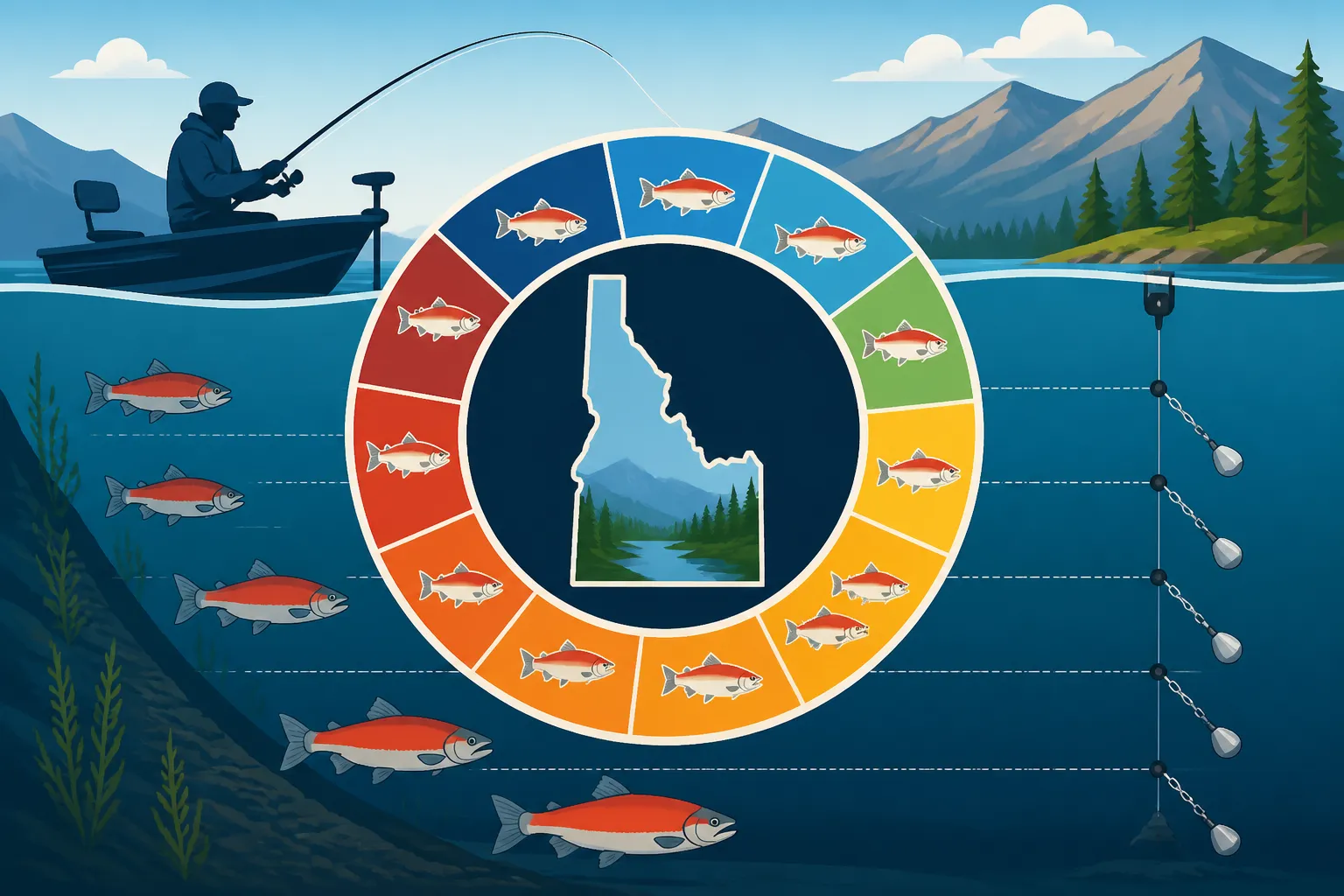
If you've ever spent hours trolling for kokanee salmon in Idaho, only to come back with an empty cooler and a bruised ego, you know the frustration. These landlocked sockeye can be incredibly elusive, often holding to very specific depths that seem to change with the wind, the sun, or even just their mood. But what if there was a way to take some of the guesswork out of it? Understanding seasonal depth patterns can be a game-changer, helping you dial in your trolling presentation and increase your chances of success, and this guide will walk you through creating and using a trolling depth chart by month for Idaho kokanee.
Understanding Kokanee Behavior Throughout Idaho's Fishing Seasons
Kokanee salmon are fascinating fish, and their behavior, particularly their preferred depth, is heavily influenced by the changing seasons. It's not just about how warm the surface water gets; it's a complex dance involving water temperature, light penetration, food sources, and even spawning instincts. Thinking about these factors month-by-month helps us build a mental map of where these fish are likely to be hiding.
Spring: Post-Ice Out and Early Warming Trends
As the ice finally recedes from Idaho's kokanee lakes in early spring, usually around March or April, a new fishing season begins. The water is still quite cold, and the kokanee are often scattered, moving from deeper winter haunts into more accessible areas. During this time, they're not yet tightly schooled in the thermocline because it hasn't fully formed. Instead, they're often found shallower than you might expect.
In the first few weeks after ice-out, look for kokanee anywhere from the surface down to about 20-30 feet. They might be chasing zooplankton blooms that are beginning to appear in the upper water column as sunlight penetrates more deeply. This is a fantastic time for shallower trolling with lighter gear. As the days lengthen and the sun gains strength, you'll notice a gradual push deeper, but not a drastic one yet. It's a period of transition, and staying flexible with your depth finder and your presentations is key. Don't be afraid to experiment with your depths, running multiple lines at varying levels until you find where the fish are concentrating.
Summer: The Thermocline and Deep Water Holds
Summer is when kokanee really settle into their routine, and understanding the thermocline becomes paramount. As Idaho's lakes warm up, distinct layers of water form: a warm upper layer (epilimnion), a colder bottom layer (hypolimnion), and a transition zone in between called the thermocline. Kokanee are cold-water fish, generally preferring water temperatures in the 50s Fahrenheit, which is why the thermocline becomes their prime real estate.
From late May through August, you'll typically find kokanee congregating in or just above the thermocline. This depth can vary significantly between lakes. A deep, clear lake like Lake Coeur d'Alene might have a thermocline starting at 40 feet and extending down to 70 or 80 feet, while a shallower reservoir might see it much higher. Learning how to use a fish finder is crucial during this period to pinpoint this thermal layer. They're often feeding heavily during the summer, packing on fat for the upcoming spawn, making them excellent targets if you can find their depth. During bright sunny days, they'll often go deeper within the thermocline or even just below it to escape the intense light, moving shallower during low light conditions or cloudy days. Our article, "What Depth Kokanee Hold at in Summer on Idaho Lakes " goes into even more detail about this critical summer period.
Fall: Pre-Spawn Migration and Shallowing Up
As summer fades and autumn colors begin to paint the Idaho landscape, kokanee start their pre-spawn migration, and their depth patterns can shift once again. While the thermocline might still be present in early fall, falling surface temperatures begin to break it down. As the entire water column cools, kokanee often start to move shallower as they prepare for their spawning runs up tributary streams or along lake shorelines.
You might find them anywhere from 20 to 60 feet, often cruising along structure or near river mouths as they stage for their journey. This is a time when the fish can be very active and aggressive, driven by the instinct to spawn. The cooler water means they are more comfortable in shallower depths than they were in mid-summer. However, they can still be a bit finicky. The key is to pay attention to current water temperatures and look for fish staging points. As the water cools further into late fall, the entire lake can become a more uniform temperature, and kokanee might be found at various depths as they complete their spawning rituals, which, tragically, is their final act.
Factors Influencing Kokanee Depth Beyond the Calendar
While the monthly calendar provides a great baseline, kokanee aren't robots. Their depth preferences are also influenced by a host of other factors that can change daily, hourly, or even minute-by-minute. Ignoring these can lead to a frustrating day on the water, even if you're generally in the right "monthly" zone.
Water Temperature and Oxygen Levels
The most critical factor for kokanee is water temperature. As mentioned, they are cold-water fish, preferring temperatures in the 50-60°F range. However, it's not just about being cold; it's also about oxygen. In deeper parts of a lake, especially during summer, the coldest water can sometimes become oxygen-depleted, creating a 'dead zone' where fish simply cannot survive.
So, while your depth finder might show a school of kokanee at 60 feet, if the water at 70 feet has extremely low oxygen, they might be holding just above that threshold. This often means they are squeezed into a relatively narrow band within the thermocline where the temperature is ideal, and oxygen levels are sufficient. Pay close attention to your fish finder's temperature gauge if it has one, or use a separate temperature probe to identify these sweet spots. A sudden cold front can also temporarily push kokanee deeper as surface waters chill, only for them to rebound shallower as the weather stabilizes. It’s a dynamic environment, always changing.
Light Penetration and Weather Conditions
Just like many fish, kokanee are sensitive to light. On bright, sunny days, especially with clear water, they'll often retreat to deeper, darker water to feel more secure. They don't have eyelids, after all! This means that if your chart says 50 feet for July, but it's a bluebird day, they might be down at 60 or 70.
Conversely, on overcast days, during dawn and dusk, or when there's a chop on the water that breaks up the light, kokanee are often more comfortable moving shallower. These low-light conditions are prime times for them to be actively feeding. Even passing clouds can temporarily influence their depth. Think about it: if the sun ducks behind a big cloud, those fish might feel brave enough to move up 10 feet for a quick bite before retreating when the sun reappears. This is why continuously monitoring your fish finder and adjusting depths is essential, rather than just setting it and forgetting it.
Forage Availability and Predator Avoidance
Kokanee are filter feeders, primarily eating zooplankton. These tiny organisms also respond to light and temperature, often migrating up and down the water column throughout the day. Where the zooplankton are, the kokanee are likely to follow. Your fish finder might not always show individual zooplankton, but sometimes you'll see clouds of baitfish or even kokanee themselves feeding in a specific layer, which indicates a concentration of their food source.
Additionally, kokanee are prey for larger fish, particularly trophy rainbow trout and chinook salmon in certain Idaho waters like Lake Pend Oreille or Lake Coeur d'Alene. If there's a lot of predator activity in a certain depth range, the kokanee might choose to hold slightly shallower or deeper to avoid becoming a meal. This predator-prey dynamic is a constant chess match under the water, and it can subtly influence where you find kokanee. Understanding the local food chain can give you another edge in determining where to focus your efforts.
Crafting Your Own Monthly Trolling Depth Chart for Kokanee
While no single chart can perfectly predict kokanee behavior across all Idaho's diverse lakes, having a general framework is incredibly helpful. This framework, combined with real-time observation and adjustment, will be your most potent tool.
A General Idaho Kokanee Trolling Depth Guide
Here's a starting point for a typical Idaho kokanee lake. Remember, these are averages and highly dependent on the specific body of water, weather, and time of day. Always use your electronics to verify!
| Month | General Depth Range (Feet) | Notes & Considerations |
|---|---|---|
| March | 10-25 | Post-ice out, scattered, warming surface. Seek protected coves. |
| April | 15-30 | Gradually moving deeper, still relatively shallow. Active feeding. |
| May | 20-45 | Thermocline beginning to form. Fish follow bait. Consider mornings and evenings. |
| June | 30-60 | Thermocline well-established. Fish often suspended in this layer. Mid-day deeper. |
| July | 40-80 | Deepest average depths, especially on bright days. Key to find the thermocline. |
| August | 35-75 | Still deep in the thermocline, but watch for signs of pre-spawn movement. |
| September | 25-60 | Water cooling, thermocline breaking up. Pre-spawn staging. Can be aggressive. |
| October | 15-40 | Spawn underway or recently completed. Fish moving shallower, less focused on feeding. |
| November | 10-30 | Post-spawn, fish scattered and recovering. Target colder, oxygenated water. |
This table is a great starting point, but always verify with your electronics! For more general information on fishing throughout the year, check out our Idaho Fishing Season Calendar to plan your trips.
Utilizing Sonar and Fish Finders Effectively
Your fish finder is your best friend when chasing kokanee. It's not just for showing you individual fish; it's for understanding the whole water column. Learn to identify the thermocline (it often shows up as a distinct, often blurry line or band on your screen), and look for bait balls or schools of fish suspended within or just above it. Many modern units, like those from Humminbird or Lowrance, offer excellent clarity and features that can highlight these temperature breaks and fish arches.
Don't just run your boat blindly. Start by scanning different depths and areas. Watch for arches or lines of fish. Once you locate a school, pay attention to the depth at which they're holding. This is where your chart comes alive – comparing your observations to your estimated depths. If your chart suggests 50 feet in July but you're marking fish consistently at 65 feet, adjust your presentation to 65. Flexibility and responsiveness to what your electronics are telling you will dramatically improve your catch rate.
The Art of Experimentation: Adjusting and Fine-Tuning
Fishing for kokanee is as much an art as it is a science. Even with a depth chart and good electronics, you need to be willing to experiment. Start with the depths suggested by your chart or your fish finder, but don't be afraid to try different levels. Run multiple lines at varying depths if you can, especially when you're first figuring out the bite. Maybe one line at 50 feet, another at 55, and a third at 60.
Pay attention to what's hitting. If a specific depth is consistently getting bites, then focus your efforts there. If you're not getting any action, adjust by 5-10 feet increments up or down. Changing your trolling speed, lure color, or dodger size can also make a difference, even at the "right" depth. Don't be afraid to deviate from your chart if the fish are telling you something different. Every day, every lake, every weather pattern can present unique challenges, and those who adapt quickly are often the most successful. Our guide on Best Trolling Speed for Kokanee might also help you fine-tune your approach.
Essential Gear for Reaching and Maintaining Kokanee Depths
To consistently hit those precise depths where kokanee are holding, you need the right tools. Simply casting and hoping isn't going to cut it when the fish are suspended 60 feet down. This is where specialized trolling gear comes into play.
Downriggers: Precision Depth Control
Downriggers are arguably the most effective tool for precision depth control when trolling for kokanee. These devices allow you to set your lure or bait at a specific, desired depth and keep it there, regardless of your trolling speed or line angle. They use a heavy cannonball weight, attached to a strong cable, which is lowered to the chosen depth. Your fishing line is then clipped to the downrigger cable with a release clip. When a fish strikes, the line pops free from the clip, and you're fighting the fish directly, without the drag of the weight.
Using downriggers is fantastic because you can fish multiple lines at different depths, systematically covering the water column until you find where the kokanee are. You can easily adjust depths with the push of a button, making quick changes based on your fish finder readings or a sudden bite. If you're serious about targeting these depth-sensitive fish, a pair of quality downriggers is a worthwhile investment. You can find various models, from manual to electric, and all the necessary accessories on platforms like Amazon.
Lead Core Line: Depth by Color and Speed
For anglers without downriggers, or those looking for a simpler setup, lead core line is an excellent alternative for reaching deeper kokanee. Lead core line is essentially a braided line with a lead filament woven into its core. The lead causes the line to sink, and its sinking rate is relatively consistent per "color" segment (most lead core lines change color every 10 yards, giving you a visual cue for how much line is out).
Generally, each color of lead core line will get your lure down approximately 5-7 feet at typical kokanee trolling speeds. So, if you want to fish at 30 feet, you'd let out 4-6 colors, depending on your lure, speed, and line diameter. It takes some practice to get precise, but it's a reliable method. You'll typically spool lead core onto a large capacity reel, splicing it to a monofilament or fluorocarbon leader where you attach your dodger and lure. Make sure your rod has a sensitive tip, as the lead core itself has very little stretch. Just like downriggers, a good selection of lead core line can be found on Amazon, allowing you to stock up for different depth needs.
Specialized Dodgers, Flashers, and Lures
Beyond how you get your lure to depth, what you put at the end of your line is equally important. Kokanee are visual feeders, attracted by flash and vibration. Dodgers and flashers are critical components, designed to create commotion in the water, mimicking schools of baitfish and drawing kokanee in. Dodgers provide a wider, erratic side-to-side action to your lure, while flashers rotate, creating more intense flash and vibration. The choice between them often comes down to personal preference and what the fish are responding to on a given day.
Behind your dodger or flasher, you'll typically run a small kokanee specific lure, such as a mini hoochie, a small spoon, or a wedding ring spinner. These lures are often brightly colored (pinks, oranges, greens) and sometimes tipped with a small piece of corn, which kokanee seem to find irresistible. Scent can also play a huge role, so don't shy away from adding a fish attractant. Experimenting with different lure combinations and colors, even when you're at the right depth, can be the difference between a slow day and a banner day. Many anglers keep a tackle box full of various dodgers and lures, readily available at sporting goods stores or online marketplaces like Amazon, allowing for quick changes to match the conditions. Our comprehensive Best Lures for Idaho Kokanee Fishing guide can provide more specific recommendations.
Advanced Strategies and Seasonal Nuances for Kokanee Success
Once you've mastered the basics of depth finding and gear, it's time to refine your approach. Kokanee fishing isn't just about getting a lure to the right depth; it's about understanding the subtle ways these fish respond to their environment and tailoring your tactics accordingly.
Trolling Speeds and Patterns for Optimal Presentation
The speed at which you troll can dramatically affect not only your lure's action but also the depth it runs. Too fast, and your lures might rise; too slow, and they might sink too deep or lose their enticing movement. For kokanee, a common trolling speed is between 1.0 and 1.8 miles per hour. However, this is just a starting point. Sometimes, a slight increase or decrease in speed can trigger a bite when nothing else is working.
Experiment with your speed throughout the day. Watch your rod tips to ensure your dodgers and lures are working properly; they should have a steady thump or wobble. Beyond speed, your trolling pattern matters. Don't just go in a straight line. Incorporate S-turns, figure-eights, or wide circles. As your boat turns, your inside lines will slow down and sink, while your outside lines will speed up and rise. This varying action can often entice a strike from following kokanee that were hesitant to commit to a steady presentation. These changes in depth and action can be incredibly effective, making them a crucial part of your Idaho Trolling Techniques Guide.
Bait and Scent: The Irresistible Enhancers
While dodgers and lures do most of the work, adding bait and scent can give you a significant edge, particularly with finicky kokanee. The most popular bait for kokanee by far is shoepeg corn, often dyed in bright colors and infused with various scents. The texture and sweet flavor seem to be incredibly attractive to kokanee.
Prepare your corn by soaking it in a brine with garlic, anise, or a commercially available kokanee scent. These scents not only mask human odors but also create a scent trail in the water that can draw fish from a distance. Another effective bait is a small piece of worm, particularly when combined with a wedding ring spinner. Always check local regulations regarding bait use, as some waters may have restrictions. The combination of visual attraction, erratic movement from your dodger, and an enticing scent trail is often the magic formula for consistent kokanee bites. Don't underestimate the power of a little extra "flavor" on your hook!
Reading the Water and Adapting to Local Conditions
Every Idaho lake is a unique ecosystem, and kokanee populations within them can vary in behavior. What works on Lake Coeur d'Alene might be slightly different on Payette Lake or Anderson Ranch Reservoir. Therefore, it's crucial to learn to "read the water" and adapt to the specific conditions you encounter. Pay attention to water clarity; clearer water might mean fish are deeper due to light penetration. Turbid water might keep them shallower. Observe surface activity, like insect hatches or baitfish schools, which could indicate where kokanee might be feeding.
Talk to other anglers at the boat ramp or local tackle shops. They often have invaluable, real-time insights into what's working. Check online fishing reports or forums specific to your chosen lake. This combination of general knowledge, personal observation, and local intelligence will allow you to fine-tune your monthly depth chart and make informed decisions on the water. The more you fish, the more intuitive this adaptation becomes, turning you into a true kokanee whisperer. For more specific insights into this sought-after species, you might want to delve into our Idaho Kokanee Fishing Guide.
Disclaimer
This article is for general informational purposes only and does not constitute professional advice. Laws, prices and regulations vary by location and change over time. Consult a qualified professional for guidance on your specific situation.