How to Anchor a Boat for Sturgeon Fishing on the Snake River
Trying to hook into one of the Snake River's legendary sturgeon is an incredible experience, but the river's powerful currents and often snag-filled bottom can make anchoring a real headache for anglers. It's frustrating to constantly drag anchor, re-position, or worse, lose your gear because your boat isn't holding steady. This guide will walk you through everything you need to know about effectively and safely anchoring your boat for sturgeon fishing on the Snake River, ensuring you stay put when that monster bite hits.
Why Proper Anchoring is Crucial for Snake River Sturgeon Fishing
Fishing for white sturgeon on the Snake River isn't like casting for trout in a calm mountain lake. These are powerful, ancient fish that demand respect and specialized tactics, and that starts with how you hold your position on the water. A secure anchor setup isn't just about convenience; it's fundamental to safety, success, and even the ethics of fishing for these magnificent creatures.
The Power of the Snake River Current
The Snake River, especially in prime sturgeon territory, is a force of nature. Its currents can be deceptively strong, even in seemingly calm stretches, and they can shift dramatically with changes in flow from upstream dams or natural variations. Imagine you've spent hours meticulously preparing your bait, scouting the perfect deep hole where you know a giant sturgeon might be lurking, only for a subtle increase in current to slowly drag your boat downstream. Not only does this move you off your carefully selected spot, but it can also tangle your lines with other boats or shore-based anglers, disrupt your bait presentation, and force you to waste valuable fishing time re-setting.
More critically, a dragging anchor in a strong current can quickly become a safety hazard. If your anchor snags unexpectedly while dragging, the sudden stop can be jarring, potentially throwing gear—or even people—off balance. If the current is strong enough, it can also pull your boat into dangerous structures like submerged rocks, fallen trees, or even other vessels, leading to damage or worse. Understanding and respecting the river's power is the first step in mastering your anchor system.
Protecting Your Boat and Gear
Let's be honest, fishing gear isn't cheap, and neither is your boat! An improperly deployed or inadequate anchoring system puts both at risk. A flimsy anchor or a worn-out anchor line is a recipe for disaster on the Snake. If your anchor line snaps, you're not only losing an expensive piece of equipment to the river bottom but you're also suddenly adrift, potentially in a busy stretch of river. This can lead to collisions or rapidly drifting out of safe navigation channels.
Beyond the anchor itself, a boat that's not securely anchored makes it difficult to manage your lines. When targeting sturgeon, you're often dealing with heavy tackle, large baits, and multiple rods. If your boat is constantly swaying or slowly drifting, your lines can become tangled, wrapped around the prop, or snagged on underwater debris. This can result in lost tackle, broken rods, and a significant amount of frustration. A secure anchor provides a stable platform, allowing you to focus on the fishing, not on fighting your own boat. It's an investment in the longevity of your equipment and the peace of mind during your trip.
Maximizing Your Fishing Success
Ultimately, we're all out there to catch fish, and proper anchoring directly impacts your chances of success, especially when you're specifically targeting the impressive sturgeon. These fish, while massive, can also be quite finicky. They tend to hold in specific ambush points – deep holes, current seams, behind large boulders, or near structure where they can conserve energy and wait for food. If your boat is constantly moving, even subtly, your bait is likely moving with it, pulling out of the strike zone and making it less appealing to a discerning sturgeon.
A firmly anchored boat allows you to precisely position your bait and keep it in the optimal location for extended periods. This is crucial for sturgeon fishing, which often involves soaking baits for a while. You can monitor your rods without the distraction of drift, ensuring your line is tight and your bait is presented perfectly. When a sturgeon does bite, a stable boat provides a solid platform to set the hook firmly and begin the fight. Trying to fight a powerful fish like a sturgeon from a boat that's actively dragging anchor or swaying erratically is incredibly challenging and increases the risk of losing the fish. Stability is your friend, letting you concentrate on the battle and, hopefully, bringing that incredible fish alongside for a safe release, as required by Idaho's catch-and-release rules for sturgeon.
Essential Anchoring Gear for Sturgeon Fishing on the Snake River
You wouldn't try to fight a Snake River sturgeon with a trout rod, right? The same logic applies to your anchoring system. The sheer power of the river and the size of the fish you're targeting demand robust, specialized gear. Skimping here isn't just bad angling; it's a safety concern. Let's break down what you absolutely need to hold your ground.
Choosing the Right Anchor Type
When you're dealing with the Snake River's strong currents and varied bottom, a lightweight grapple or fluke anchor designed for smaller, calmer waters just won't cut it. For serious sturgeon fishing, you're going to want something that truly digs in and holds.
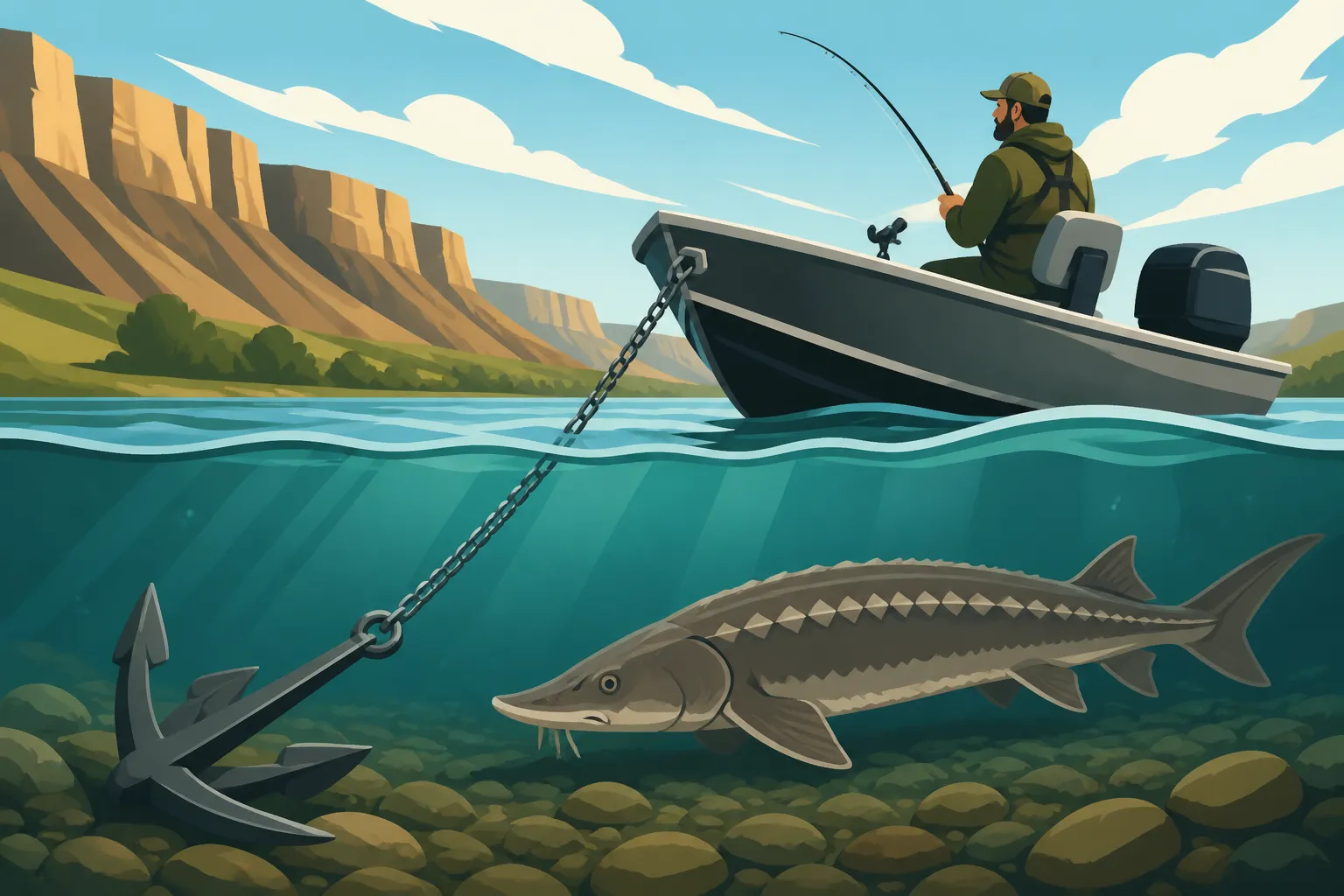
- Box Anchors: These are incredibly popular and effective for river fishing. They are heavy, often pyramid or cube-shaped, and designed to dig into soft or silty bottoms while resisting rolling in current. Their weight, combined with their shape, creates significant holding power. Many are designed with a sliding retrieval ring for snag-free recovery.
- Heavy River Anchors (Rock/Pyramid Anchors): These are essentially just very heavy chunks of metal, often shaped to dig or simply use sheer weight to hold. While effective for holding, they can be prone to snagging if not used with a good breakaway system.
- Danforth/Fluke Anchors: While excellent in sandy or muddy lake bottoms, these generally aren't recommended for the Snake River's typically rocky or swift-current conditions. They don't dig in as effectively in hard bottoms and can drag easily in strong currents.
For sturgeon on the Snake, you'll want an anchor that's significantly heavier than what you might use for the same size boat on a lake. For a 16-20 foot boat, you might consider an anchor in the 25-40 pound range, or even heavier if you're consistently in very swift current or adverse conditions. Many anglers even utilize two anchors—one off the bow and one off the stern—for ultimate stability and precise boat positioning.
Anchor Line and Chain
The anchor is only as good as the line connecting it to your boat. This is not the place to compromise on quality or length.
-
Anchor Line (Rode): You'll want a strong, durable, and relatively stretchable line. Nylon is a popular choice because its elasticity helps absorb shock from waves or current fluctuations, reducing the stress on your anchor and boat. Polyester also works well. Aim for a line with a breaking strength well beyond the expected load, especially considering the added strain of fighting a massive fish and the current simultaneously. The diameter should be comfortable to handle, even with gloves.
-
Scope is King: This is perhaps the most critical concept in anchoring. "Scope" refers to the ratio of the length of your anchor line to the depth of the water (plus the height of your bow roller above the water). A good rule of thumb for river fishing in moderate conditions is a minimum 7:1 scope, meaning for every 10 feet of water depth, you want at least 70 feet of anchor line out. In very strong currents or rougher conditions, you might need 10:1 or even more. Insufficient scope is the most common reason anchors drag.
-
Anchor Chain: This is often overlooked but incredibly important. A length of heavy galvanized chain (typically 6-10 feet, but sometimes more depending on the anchor and boat size) attached between your anchor and the anchor line serves several vital purposes:
- Angle of Pull: The weight of the chain helps to pull the anchor shank parallel to the riverbed, ensuring the anchor flukes or box edges dig in properly. Without chain, the anchor line might pull the anchor upwards, causing it to skip or drag.
- Abrasion Resistance: The chain protects your anchor line from chafing on rocky or abrasive river bottoms, which can quickly wear through rope.
- Added Weight: It provides extra weight directly at the anchor, increasing its holding power.
You can find a great selection of these robust anchoring components on Amazon or at local sporting goods stores specializing in marine supplies. Remember, buy quality once, cry once!
Safety and Retrieval Tools
Even with the best gear, things can go wrong. Being prepared for snags or needing to cut free in an emergency is paramount.
- Breakaway Systems: These are simple yet ingenious setups that allow you to retrieve a snagged anchor. Typically, you rig your chain to the anchor's crown (the opposite end from the digging flukes) with a heavy-duty zip tie or thin copper wire. The anchor line is then attached to the shank, but also "tied off" to the crown with the zip tie. If the anchor gets snagged, you pull hard, breaking the zip tie, and the anchor is then pulled from the crown end, usually freeing it.
- Anchor Buoy and Trip Line: An anchor buoy attached to a dedicated "trip line" (a lighter line attached to the anchor's crown) can be incredibly useful. If your main anchor line breaks or you need to recover a deeply snagged anchor, you can use the trip line to pull the anchor from the opposite direction, often freeing it. The buoy also marks your anchor's position clearly, which is helpful in busy areas.
- Gloves: Always wear sturdy gloves when handling anchor lines. They protect your hands from rope burn and potential cuts, especially when dealing with heavy, wet line under tension.
- Sharp Knife/Cutting Tool: In a worst-case scenario, you might need to cut your anchor line to prevent your boat from being pulled into danger. Keep a sharp, easily accessible knife on board, preferably one that floats or is attached to the boat.
By investing in and understanding this essential gear, you'll be well-equipped for a safe and successful sturgeon fishing adventure on the mighty Snake River. You might even consider having a look at an Idaho Fishing Gear Guide by Season to ensure you're covered for other equipment needs.
Step-by-Step Guide to Anchoring for Sturgeon on the Snake River
Alright, you've got your heavy-duty anchor, plenty of line, and a good length of chain. Now, let's talk about the actual process of getting that anchor to hold fast on the Snake River. This isn't just about tossing it overboard; it's a careful dance with the current and the riverbed.
Scouting Your Spot
Before you even think about dropping anchor, you need to pick your battleground. Sturgeon aren't everywhere, and neither are ideal anchoring spots. This phase is crucial for both fishing success and safety.
- Look for Structure and Deep Holes: Sturgeon love to hang out in deeper pockets, behind large current breaks (like submerged boulders or ledges), or along dramatic depth changes. Use your sonar to identify these areas. Pay attention to how the current flows around potential holding spots. Fish often position themselves where the current brings food but they don't have to fight the main force of the water.
- Observe the Current: Watch the surface of the water, look at how debris floats, and note any eddies or seams. You'll need to know the strength and direction of the current to position your boat correctly and ensure your anchor holds. Stronger currents require more scope and heavier anchors.
- Consider the Bottom Composition: While you can't see it, your sonar might give you clues about whether the bottom is soft silt, gravel, or rocky. Box anchors do well in softer bottoms, but even rocky bottoms can offer places for an anchor to "bite." Avoid areas with excessive submerged debris if possible, as these are prime snag zones.
- Give Other Anglers Space: The Snake River can get busy. Be mindful of other boats and shore anglers. Plan your anchor drop so you're not drifting into their lines or encroaching on their spot. Part of the Idaho Fishing Regulations Explained involves respecting other anglers.
Once you've identified your ideal fishing zone, mentally picture where you want your boat to end up, and then figure out where you need to start your approach from upstream of that spot.
The Approach and Drop
This is where technique comes into play. You want to drop your anchor upstream of your target fishing spot, allowing the current to help set it and position your boat.
- Approach Upstream and Slightly Past: Drive your boat upstream of your desired fishing location. If you want to fish a hole, motor a bit past the upstream edge of that hole. The exact distance depends on the current speed and depth, but typically you'll want to be 50-100 feet or more upstream.
- Slow Down, Kill Power (or Idle in Neutral): As you reach your drop point, slow your boat significantly. For lighter currents, you can often just shift into neutral and let the current take over. In stronger currents, you might need to kill the engine entirely, ensuring it doesn't get fouled by the anchor line.
- Drop the Anchor, Don't Throw: Gently lower your anchor overboard. Never throw it with force. This can cause the chain and line to tangle, leading to a foul set or, worse, a wrapped prop. Let the anchor hit the bottom, then begin slowly paying out line as your boat drifts downstream with the current. This helps the anchor drag along the bottom, allowing it to "find" a spot to dig in.
- Pay Out Sufficient Scope: Continue to pay out anchor line as your boat drifts back towards your desired fishing position. Remember the crucial 7:1 (or greater) scope. Don't be shy with the line! Many anglers underestimate how much line they truly need. As you drift back, keep an eye on your sonar to see when you're over your target fishing zone.
Setting and Testing the Anchor
Once you've drifted back into position and paid out enough line, it's time to ensure that anchor is truly dug in.
- The "Power Set" (Carefully): With the anchor line tight, slowly engage your boat's engine in reverse (or forward, depending on your setup) and apply a small amount of power, gently pulling against the anchor. This "sets" the anchor by digging it deeper into the riverbed. You'll feel the tension build, then the boat should stop moving. Be careful not to apply too much power or you could break the anchor free.
- Visual Confirmation and Feeling: Watch your boat's position relative to the shore or known landmarks. Is it holding steady? You should feel the anchor line "singing" with tension, but without any shuddering that would indicate dragging. Look at your GPS if you have one – a stationary position is key.
- Confirm with Sonar/Depth Finder: Check your sonar. Is your boat holding directly over the structure or depth you intended to fish? Fine-tuning your position can make all the difference.
Adjusting Your Position
Sometimes, even with a perfect drop, you might be a few feet off your ideal spot. This is where a second anchor or careful line manipulation comes in handy.
- Using Two Anchors: Many serious sturgeon anglers use a two-anchor system (bow and stern). Once your primary bow anchor is set, you can drop a lighter stern anchor upstream of your desired stern position. As the stern anchor sets, you can then use both lines to precisely pull your boat fore and aft, or even slightly side to side, to dial in your exact boat angle and location over the fishing zone. This provides incredible stability, especially in strong cross-currents.
- Line Adjustments: If you're using only one anchor, you can sometimes make minor adjustments by carefully letting out or taking in a few feet of line. However, for significant repositioning, it's usually better to retrieve the anchor and re-drop.
- Leveraging the Current: Once you are securely anchored, the current will spread your scent trail and bait effectively downstream, hopefully attracting those big sturgeon. Understanding Idaho Fishing Techniques Guide specific to various species will also help you make the most of your anchored position.
By following these steps, you'll greatly increase your chances of staying put and successfully targeting those magnificent Snake River sturgeon.
Common Anchoring Mistakes and How to Avoid Them
Even seasoned anglers can sometimes make mistakes when it comes to anchoring, especially in dynamic environments like the Snake River. Recognizing these common pitfalls and understanding how to avoid them can save you a lot of grief, lost gear, and even prevent dangerous situations.
Insufficient Scope
This is, hands down, the most frequent reason anchors drag, and it's particularly problematic in a powerful river system. Imagine trying to hold a kite in a strong wind with only a few feet of string; it's going to go everywhere. An anchor works by digging horizontally into the bottom, and a long scope allows the anchor to lie flat and dig in at a low, effective angle.
- The Mistake: Not paying out enough anchor line. Anglers often want to stay close to their drop point, or they simply underestimate the depth and current. They might put out a 3:1 or 4:1 scope, which causes the anchor line to pull almost vertically on the anchor. Instead of digging in, the anchor just skips or rolls across the bottom.
- How to Avoid: Always, always pay out sufficient scope. Remember the 7:1 rule of thumb for rivers, and be prepared to go even higher (8:1, 10:1) if the current is exceptionally strong, the bottom is notoriously slippery, or if you're experiencing any dragging. It might feel like you're letting out an excessive amount of line, but that extra line is your best insurance against dragging. It's better to use too much line than not enough.
Wrong Anchor Type for Conditions
As discussed earlier, one anchor does not fit all. Using the wrong tool for the job is never effective, and it can be dangerous when anchoring a boat.
- The Mistake: Using a lightweight, small, or inappropriate anchor type for the Snake River's strong currents and often rocky or silty bottom. A small fluke anchor might work fine for small boats in calm lake conditions, but it will almost certainly drag in the Snake. Similarly, trying to rely solely on sheer weight without an anchor that's designed to dig (like a box anchor) can lead to frustration.
- How to Avoid: Invest in the right anchor for the job. For sturgeon fishing on the Snake, a heavy box anchor or a purpose-built river anchor (often 25-40+ lbs for most boats) is typically your best bet. If you're unsure, ask experienced local anglers or consult with a marine supply specialist who understands river conditions. Always consider having a second, perhaps slightly lighter, anchor as a stern anchor for added stability and precise positioning.
Not Testing the Set
Dropping the anchor is only half the battle. Assuming it's holding without confirmation is a gamble you don't want to take.
- The Mistake: Dropping the anchor, letting out some line, and then immediately starting to fish without verifying that the anchor is securely dug into the bottom. The boat might feel like it's holding for a few minutes, only to slowly start drifting downstream.
- How to Avoid: Always perform a proper "power set" (as described in the previous section) by gently pulling back on the anchor with your engine. After that, take a few minutes to visually confirm your position relative to landmarks on shore. If you have a GPS, check for any drift. Pay attention to the feel of the anchor line – it should be taut and steady, not "bumping" or "skipping" along the bottom. If there's any doubt, retrieve, move slightly upstream, and re-drop. Your fishing success, and your safety, depend on a solid set.
Over-Anchoring or Dropping in the Wrong Spot
While not enough anchor is bad, sometimes too much or a poor drop can also create issues, especially during retrieval.
- The Mistake: Dropping the anchor too quickly, causing the line and chain to foul. Or, dropping the anchor directly over the spot you want to fish, rather than upstream of it, which makes it impossible to achieve proper scope and set. Another mistake is dropping too close to known snags without a breakaway system.
- How to Avoid: Always approach your desired spot from upstream, giving yourself plenty of room to drift back and pay out line. Gently lower the anchor; don't just heave it over. If you're in an area prone to snags, ensure your breakaway system is properly rigged. Sometimes, if you're having persistent trouble with snags, it's worth rethinking your chosen spot. Remember, the goal is to fish for the amazing sturgeon, but safety is always the priority. By being mindful of these common mistakes, you'll be well on your way to a secure and successful anchoring experience on the Snake River. This stability will prove invaluable when it comes time to How to Fight a Sturgeon on the Snake River.
Retrieving Your Anchor Safely
After a thrilling day of fishing for sturgeon on the Snake River, the last thing you want is a difficult or dangerous anchor retrieval. A proper retrieve isn't just about getting your anchor back; it's about doing so without damaging your boat, injuring yourself, or getting into a tangled mess.
Standard Retrieval Techniques
Most of the time, retrieving your anchor will be a straightforward process, provided you've set it correctly with adequate scope.
- Motor Upstream Slowly: The easiest way to retrieve an anchor that's dug in is to use your boat's engine. Start your engine and slowly motor directly upstream, following the line of your anchor rode. As you move, the boat's momentum will reduce the tension on the anchor line and pull the anchor from the opposite direction of its set.
- Take Up Slack Gradually: As you motor upstream, continuously and steadily take up the slack in your anchor line. Don't try to rip the anchor free. You want to ease it out of the bottom. You'll feel it break free when it does.
- Pull Straight Up: Once the anchor is free from the bottom, continue motoring slowly over the top of where it was set. This allows you to pull the anchor straight up from above, minimizing the chance of it re-snagging or getting caught on another part of the bottom.
- Clean and Inspect: As the anchor comes aboard, take a moment to clean off any mud or debris. Inspect the anchor, chain, and line for any signs of wear, cuts, or damage. Address any issues before your next trip. This is also a good time to ensure your breakaway system is still intact or reset if it was deployed.
Dealing with Snags
Even with the best preparation, snags happen on the Snake River. It's an inevitable part of fishing in a dynamic river environment. The key is to handle them calmly and safely.
- Don't Just Pull Harder: Your first instinct might be to pull with all your might, but this is often counterproductive. Pulling harder can wedge the anchor deeper into a crevice or cause your anchor line to snap, resulting in a lost anchor.
- Utilize Your Breakaway System: If you rigged a breakaway system (highly recommended for sturgeon fishing), now is the time to use it. Motor slowly around the snagged anchor, pulling from different angles. If the anchor is truly stuck, apply a strong, steady pull in the direction that puts maximum tension on the breakaway connection (usually pulling from directly above or slightly past the anchor). The zip tie or light wire should snap, allowing you to retrieve the anchor from its crown, often freeing it easily.
- Use an Anchor Buoy and Trip Line: If you have a separate trip line attached to the anchor's crown and marked with a buoy, you can try to retrieve the anchor by pulling this line. This allows you to pull the anchor backward, dislodging it from the snag. This is an incredibly effective method for stubborn snags.
- Maneuvering with Caution: In some cases, careful boat maneuvering can help. Motor upstream past the anchor, then drift back down on the other side of it, trying to pull it from a different angle. Always be acutely aware of the current and any obstacles around you when performing these maneuvers. Never put yourself or your boat in a dangerous situation to save an anchor. Sometimes, cutting the line is the safest, albeit most expensive, option.
- When to Cut the Line: If all else fails and the anchor is irretrievably snagged, and attempting further retrieval puts your safety or your boat at risk, it's time to cut the line. This is why you keep a sharp knife accessible. It's a tough decision, but a boat and a life are worth far more than an anchor. Losing an anchor is frustrating, but it's part of the game. Just make sure you know Where to Buy an Idaho Fishing License and replacement gear before your next trip!
Stowing Your Anchor
Once your anchor is free, don't just leave it flopping around on the deck. A loose anchor, chain, or rope can be a trip hazard, damage your boat, or even go overboard again.
- Clean and Coil: Before bringing the anchor fully into the boat, give it a good rinse to remove mud, silt, or weeds. Coil your anchor line neatly. Many boaters use a designated anchor locker or a sturdy bucket for this purpose to keep the line from tangling.
- Secure the Anchor: Stow the anchor itself in a dedicated anchor locker, on a bow roller with a secure strap, or in a specific spot where it won't move, trip anyone, or damage the boat's finish. Ensure it's firmly secured so it can't accidentally deploy or shift while underway, especially if you're moving at speed through choppy water.
- Keep the Deck Clear: A tidy deck is a safe deck. Stow away all lines, fishing rods, and other gear once you're done fishing and preparing to move.
By following these safe retrieval and stowing practices, you'll end your sturgeon fishing adventure on the Snake River on a positive note, ready for your next exciting outing on Idaho's incredible waters.
Disclaimer
This article is for general informational purposes only and does not constitute professional advice. Laws, prices and regulations vary by location and change over time. Consult a qualified professional for guidance on your specific situation.