Difference Between Kokanee and Sockeye Salmon
It’s easy to feel a bit lost when trying to understand the nuances of salmon species, especially here in Idaho where we have such incredible fisheries. Many anglers, even those who've spent years on our rivers and lakes, often wonder about the distinction between Kokanee and Sockeye salmon. Are they the same fish? Do they behave differently? This guide aims to clear up that common confusion, giving you a deeper understanding of these fascinating fish and how to tell them apart.
Understanding Sockeye Salmon: The Anadromous Travelers
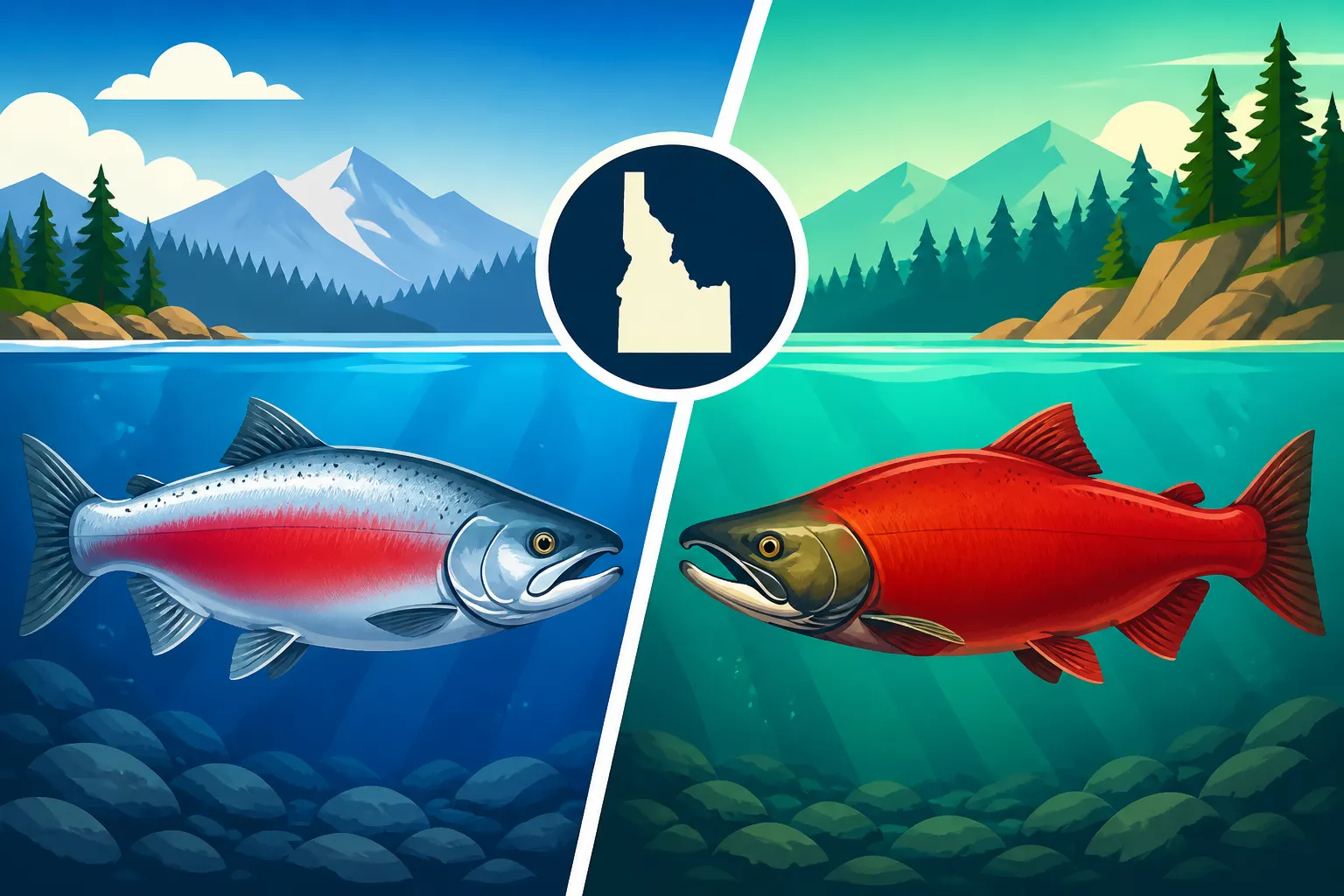
Sockeye salmon, Oncorhynchus nerka, are perhaps one of the most iconic Pacific salmon species, known globally for their vibrant red spawning colors and incredible migrations. What sets them apart primarily is their anadromous life cycle. This means they are born in freshwater, typically lakes or streams connected to lakes, migrate to the ocean to feed and grow, and then return to their freshwater birthplaces to spawn and complete their life cycle. It's an epic journey, and it's what defines a true sockeye salmon.
Imagine a tiny sockeye fry hatching in the gravel beds of a high mountain stream, perhaps one flowing into Redfish Lake in the Sawtooth Valley. For a year or two, sometimes even three, that little fish will live in the lake, growing and adapting to freshwater life. Then, driven by instinct, it begins its monumental journey. It travels downriver, through a complex system of dams and rivers like the mighty Columbia and Snake, all the way to the Pacific Ocean. Once in the ocean, it spends several years maturing, feasting on plankton and small invertebrates, developing its characteristic silver body and growing to an impressive size.
The return journey is nothing short of miraculous. These fish navigate thousands of miles back to the exact stream where they hatched, battling currents, predators, and man-made obstacles. During this migration, their bodies undergo a dramatic transformation. Their silver ocean scales give way to a brilliant, unmistakable red, and their heads turn green. Males develop a pronounced hump on their back, making them appear even more formidable. This transformation, while visually stunning, signals the end of their life cycle, as all Pacific salmon die shortly after spawning. Here in Idaho, the sockeye run is a poignant symbol of wilderness and resilience, particularly the efforts to help the endangered population return to central Idaho lakes like Redfish. For more about this incredible journey, check out Idaho Sockeye Salmon and the Redfish Lake Run.
Deciphering Kokanee Salmon: The Landlocked Relatives
Now, let's talk about Kokanee. The most crucial thing to understand about Kokanee is that they are, genetically speaking, the very same species as Sockeye salmon (Oncorhynchus nerka). The difference? Kokanee are landlocked Sockeye. They never make that incredible journey to the ocean. Their entire life cycle, from hatch to spawn, occurs exclusively within freshwater lakes and rivers. This isn't a separate species; it's an ecotype, a population that has adapted to a completely freshwater existence.
Think of it this way: some Sockeye populations, over millennia or even due to natural or man-made blockages in river systems (like glaciers or dams), lost their anadromous instinct. They found suitable conditions to thrive and complete their entire life cycle in the vastness of large freshwater lakes. These populations became what we know as Kokanee. Here in Idaho, we are incredibly fortunate to have some fantastic Kokanee fisheries, like those in Lake Coeur d'Alene, Anderson Ranch Reservoir, and Lake Pend Oreille. You can find specialized gear for targeting them, often found easily on Amazon, as trolling is a popular technique.
Because they spend their entire lives in freshwater, Kokanee tend to be significantly smaller than their ocean-going Sockeye counterparts. While a Sockeye might tip the scales at 5 to 15 pounds, a trophy Kokanee in Idaho is usually in the 2-4 pound range, though some can grow larger in nutrient-rich lakes. Their feeding habits also differ; since they aren't in the vast ocean, they primarily feed on zooplankton in the lakes. Just like Sockeye, Kokanee also undergo a dramatic color change during their spawning run, turning that same vibrant red with green heads, though on a smaller scale. These smaller, often abundant fish are a favorite among many Idaho anglers for their feisty fight and delicious table fare. If you're looking for more tips on catching these freshwater fighters, our Idaho Kokanee Fishing Guide is an excellent resource.
Key Distinctions: Unpacking the Differences in Detail
While genetically the same, the landlocked lifestyle of Kokanee creates several distinct differences from their ocean-going Sockeye relatives. Understanding these differences isn't just academic; it helps anglers understand where and when to find each fish, and how to approach catching them.
Size and Appearance
One of the most immediate and noticeable differences is size. As mentioned, ocean-run Sockeye are much larger. When they return to spawn in Idaho, they can range from 5 to over 15 pounds, with some even pushing towards 20 pounds. Their bodies are built for long, arduous ocean migrations and powerful river ascents. You'd be hard-pressed to mistake one of these ocean titans for a Kokanee during their spawning run.
Kokanee, on the other hand, are freshwater specialists. Living entirely within lakes, they typically max out at a much smaller size. Most adult Kokanee caught by anglers are between 10 and 20 inches long and weigh anywhere from 1 to 4 pounds. While some exceptional individuals might exceed this, they rarely approach the size of their anadromous cousins.
In terms of coloration, when they are not spawning, both fish share a similar silvery appearance in their respective habitats. However, the intensity of the "red" during spawning can sometimes appear more profound on the larger Sockeye, simply due to the sheer scale of the fish.
Habitat and Lifecycle
This is the fundamental divergence point. Sockeye are anadromous. They require access to the ocean for their growth phase, returning to freshwater to spawn. This means Sockeye populations are found in river systems that connect to the Pacific Ocean, like the Snake and Columbia River systems here in Idaho, as well as coastal rivers in Alaska, Canada, and the Pacific Northwest. Their lifecycle spans several years, often 4-5 years in total, with 1-3 years in freshwater as juveniles and 1-3 years in the ocean.
Kokanee are strictly freshwater. They complete their entire 2-5 year lifecycle within lakes and the tributary streams that feed them. They thrive in deep, cold, well-oxygenated lakes. Idaho's many large reservoirs and natural lakes provide ideal habitats for these landlocked fish. You won't find Kokanee heading out to sea, nor will you find ocean Sockeye living their entire lives in a lake. The presence or absence of an ocean migration pathway is the defining factor. For anglers, knowing this helps you understand Idaho Fishing Season Dates and Limits for each species.
Dietary Habits and Growth Rate
Due to their vastly different environments, their diets also vary significantly. In the ocean, Sockeye primarily consume zooplankton, small crustaceans, and sometimes larval fish, which contribute to their rapid growth and larger size. They have many fine gill rakers, specialized for filtering small food particles from the water.
Kokanee, residing in freshwater lakes, also primarily feed on zooplankton. However, the availability and density of zooplankton in freshwater lakes typically cannot support the same growth rates seen in the ocean. This limited food source is another key reason why Kokanee remain smaller. Many anglers find specific kokanee attractants or scents that can be ordered from Amazon to mimic their preferred food sources.
Behavior and Angling Approach
The differing habitats also lead to variations in behavior and, consequently, different angling approaches. Ocean-bound Sockeye are targeted during their return migration, often in mainstem rivers. The fishing for them can be quite specific, requiring knowledge of their travel lanes and preferred holding areas. Their powerful size means stout tackle is often required.
Kokanee, being lake dwellers, are typically targeted by trolling in open water, often at specific depths where schools of zooplankton (and thus Kokanee) are concentrated. Downriggers and specialized trolling setups are common. They are known for their consistent biting habits once located, and their hard fighting nature on lighter tackle makes them a blast to catch. For a comprehensive look at targeting them, refer to How to Fish for Kokanee in Idaho.
Here's a quick comparison table summarizing the main differences:
| Feature | Sockeye Salmon (Anadromous) | Kokanee Salmon (Landlocked) |
|---|---|---|
| Habitat | Freshwater (spawn/juvenile), Ocean (adult) | Entirely Freshwater (lakes/tributaries) |
| Size (Adult) | Larger (5-15+ lbs typical) | Smaller (1-4 lbs typical) |
| Lifecycle | Anadromous (migrates to ocean and back) | Landlocked (lives entire life in freshwater) |
| Diet | Zooplankton, crustaceans, larval fish (ocean) | Primarily zooplankton (freshwater) |
| Spawning Color | Brilliant Red body, Green head | Brilliant Red body, Green head |
| Longevity | 4-5 years total | 2-5 years total |
| Idaho Presence | Redfish Lake, Snake/Clearwater/Salmon Rivers | Lake Coeur d'Alene, Cascade Res., Anderson Ranch Res., etc. |
Why the Confusion? Shared Ancestry and Similar Appearance
It's completely understandable why anglers, especially those new to Idaho, might confuse these two. The primary reason for the confusion lies in their shared genetic heritage. They are, after all, the same biological species, Oncorhynchus nerka. This shared ancestry means they share many fundamental characteristics, particularly their iconic spawning colors and their preference for specific types of freshwater environments (cold, clean lakes and streams).
When a Sockeye salmon returns to spawn, its appearance is strikingly similar to a Kokanee during its own spawning run. Both develop that unmistakable bright red body and green head. If you see a fish in a river that fits this description, without knowing its migratory history, it's easy to assume they are the same in every way. However, the context of where you find them – whether in a river directly connected to the ocean or in an isolated mountain lake – is key to understanding which form you're observing.
The historical naming conventions also play a role. "Kokanee" itself is a term derived from the Indigenous peoples of the Pacific Northwest, referring to the "red fish" that live in lakes. It's a descriptor that highlights their primary characteristic rather than a distinct biological classification. Anglers often hear them referred to as "landlocked sockeye," which, while accurate, can still lead to the question: "So, what's the real difference then?" It's a matter of life history strategy, not a separate species altogether. This distinction is vital when considering Idaho Fishing Regulations Explained for each type.
Angling Implications and Regulatory Considerations
Understanding the difference between Sockeye and Kokanee isn't just for bragging rights at the local tackle shop; it has significant implications for how you fish and what rules you need to follow. Idaho's fishing regulations are designed to manage these populations sustainably, and because of their different life histories, the rules can vary considerably.
Different Fisheries, Different Rules
Idaho has distinct fisheries for Sockeye and Kokanee. The Sockeye salmon returning to Idaho are often part of endangered runs, particularly the population heading to Redfish Lake. Because of their endangered status and the monumental effort to restore them, Sockeye salmon fishing in Idaho is highly regulated and often involves very limited or no retention, or it might be entirely closed to sport fishing. If an opportunity does arise to fish for Sockeye, it typically comes with stringent rules about seasons, bag limits, and even methods, all designed to protect the fragile population. Always consult the current Idaho Fishing Regulation Brochure and Proclamation before heading out.
Kokanee, on the other hand, support robust sport fisheries in many Idaho lakes and reservoirs. These populations are generally self-sustaining or actively managed through stocking programs, providing excellent angling opportunities. Lakes like Lake Coeur d'Alene, Cascade Reservoir, and Anderson Ranch Reservoir are famous for their Kokanee fishing, with generous bag limits during open seasons. You'll find specific techniques, like trolling with dodgers and Wedding Rings, are hugely popular, and you can stock up on these specialized lures and tackle from retailers like Amazon.
Identification is Key
Knowing how to differentiate these fish in hand (or at least by their location) is paramount for staying legal. If you're fishing a river known for Sockeye runs, and you catch a red-headed, red-bodied salmon, assume it's an ocean-run Sockeye and treat it according to the specific regulations for that species and location. Conversely, if you're trolling for Kokanee in Lake Coeur d'Alene, and you catch a similar-looking fish, it's almost certainly a Kokanee, and you'd follow those regulations.
However, sometimes the lines can blur a bit, especially when juvenile Sockeye (called smolts) are migrating or when fishing in areas where both might theoretically be present, though this is rare outside of very specific situations. When in doubt, always refer to the Idaho Fish and Game regulations for the specific body of water you are fishing. It's often safer to release a fish if you're uncertain, or consult an official source. Many experienced anglers keep a small, waterproof fish identification guide, perhaps one they purchased from Amazon, in their tackle box for quick reference.
Conservation Efforts
The existence of both forms, Sockeye and Kokanee, within the same species highlights a critical aspect of conservation. Protecting the anadromous Sockeye requires complex efforts across multiple states and international borders, focusing on fish passage, ocean conditions, and habitat restoration in freshwater. The return of Sockeye to Where Idaho's Sockeye Salmon Return Each Summer is a celebrated event, but also a stark reminder of their vulnerability.
Managing Kokanee populations involves different strategies, such as lake stocking, managing predator species, and ensuring water quality in reservoirs. Both are valuable components of Idaho's diverse fisheries, but their management reflects their distinct life histories and ecological roles. The work done by Idaho Fish and Game is crucial for maintaining both healthy populations, whether they stay in the lakes or make that incredible journey to the Pacific.
Conclusion
The vibrant red fish we see in Idaho's waters, whether they are ocean-going Sockeye salmon or their landlocked cousins, the Kokanee, are a testament to the incredible adaptability of nature. While genetically the same species, their vastly different life paths—one an epic journey to the ocean and back, the other a life entirely within our freshwater lakes—create distinct populations with unique characteristics, sizes, and behaviors.
Understanding these differences not only enriches your appreciation for Idaho's diverse aquatic ecosystems but also empowers you to be a more informed and responsible angler. You'll know what to expect when you're fishing a particular water, what tackle you might need (perhaps after browsing a few options on Amazon), and most importantly, how to adhere to the regulations designed to protect these incredible fish for generations to come. So, next time you're on the water, you'll be able to spot the differences and truly appreciate the remarkable story of both the Sockeye and the Kokanee.
Disclaimer
This article is for general informational purposes only and does not constitute professional advice. Laws, prices and regulations vary by location and change over time. Consult a qualified professional for guidance on your specific situation.