Where to Catch Kokanee on Lake Coeur d’Alene
It can feel like you're searching for a needle in a haystack when you're trying to pinpoint kokanee salmon in a massive body of water like Lake Coeur d'Alene. This beautiful, sprawling lake holds an incredible fishery, but those landlocked sockeye can be notoriously finicky, moving with the seasons and the plankton blooms they feed on. If you've spent hours trolling without a single bite or just aren't sure where to even start, don't worry—this guide is designed to break down the mystery and help you find those elusive silver bullets.
Unraveling Kokanee Behavior in Lake Coeur d'Alene
Understanding where to catch kokanee really starts with understanding them. These aren't your typical trout that might hang out near structure or ambush baitfish. Kokanee are essentially landlocked sockeye salmon, and they have some unique traits that dictate their movements and preferences, especially in a large, deep lake like Coeur d'Alene. Once you grasp their seasonal patterns and diet, you'll be much better equipped to predict their whereabouts.
Seasonal Movements and Depths
Kokanee are cold-water fish, meaning their comfort zone is generally in water temperatures ranging from the mid-40s to low 60s Fahrenheit. This preference is the primary driver behind their seasonal migration patterns in Lake Coeur d'Alene.
In the spring, usually right after ice-out and into early summer, the entire lake is relatively cool, and kokanee can be found higher in the water column, often between 10 to 40 feet deep. This is a fantastic time for anglers because they're more accessible and often quite active as they bulk up. They might be found over deeper channels or cruising the vast open water areas. As the summer progresses and surface temperatures begin to soar, kokanee will retreat to deeper, cooler thermal layers. This is when anglers truly need to master techniques for fishing deeper water, often 50 to 100 feet down, sometimes even more. The depth they prefer can vary from week to week, even day to day, based on thermocline development and plankton distribution. Come fall, as the lake's surface cools and begins to "turn over," kokanee might once again become more active and spread out across different depths before their spawning run begins in late fall, primarily in rivers like the Coeur d'Alene River or the various creeks that feed the lake.
Diet and Foraging Habits
Unlike predatory fish that chase down minnows or insects, kokanee are primarily planktivores, meaning they feed on zooplankton. This tiny, microscopic aquatic life forms the base of their food chain, and the kokanee literally follow the food.
This plankton-driven diet means that kokanee aren't typically found near rocky points or submerged timber, which are usually havens for other species. Instead, they’ll be in the open water, suspending over great depths, often in schools, sifting through the water for their next meal. Their mouths are small, designed for these tiny organisms, which is why artificial lures for kokanee are generally small, brightly colored, and designed to mimic the movement of a school of plankton or a small invertebrate. Understanding this feeding behavior is crucial because it tells you that active searching with electronics and precise depth control are paramount. You can’t just cast a big spoon and expect to hit pay dirt; you need to target the invisible clouds of plankton they’re grazing on. If you're struggling to locate these schools, checking out a guide through platforms like FishingBooker can provide insights into current patterns and hot zones.
Prime Locations and Structure for Kokanee Success
While kokanee roam widely, certain areas of Lake Coeur d'Alene consistently prove to be more productive. These aren't "structures" in the traditional sense of a submerged log or a rock pile, but rather broader zones that concentrate kokanee due to depth, currents, or historical patterns.
The Southern Arm and Bays
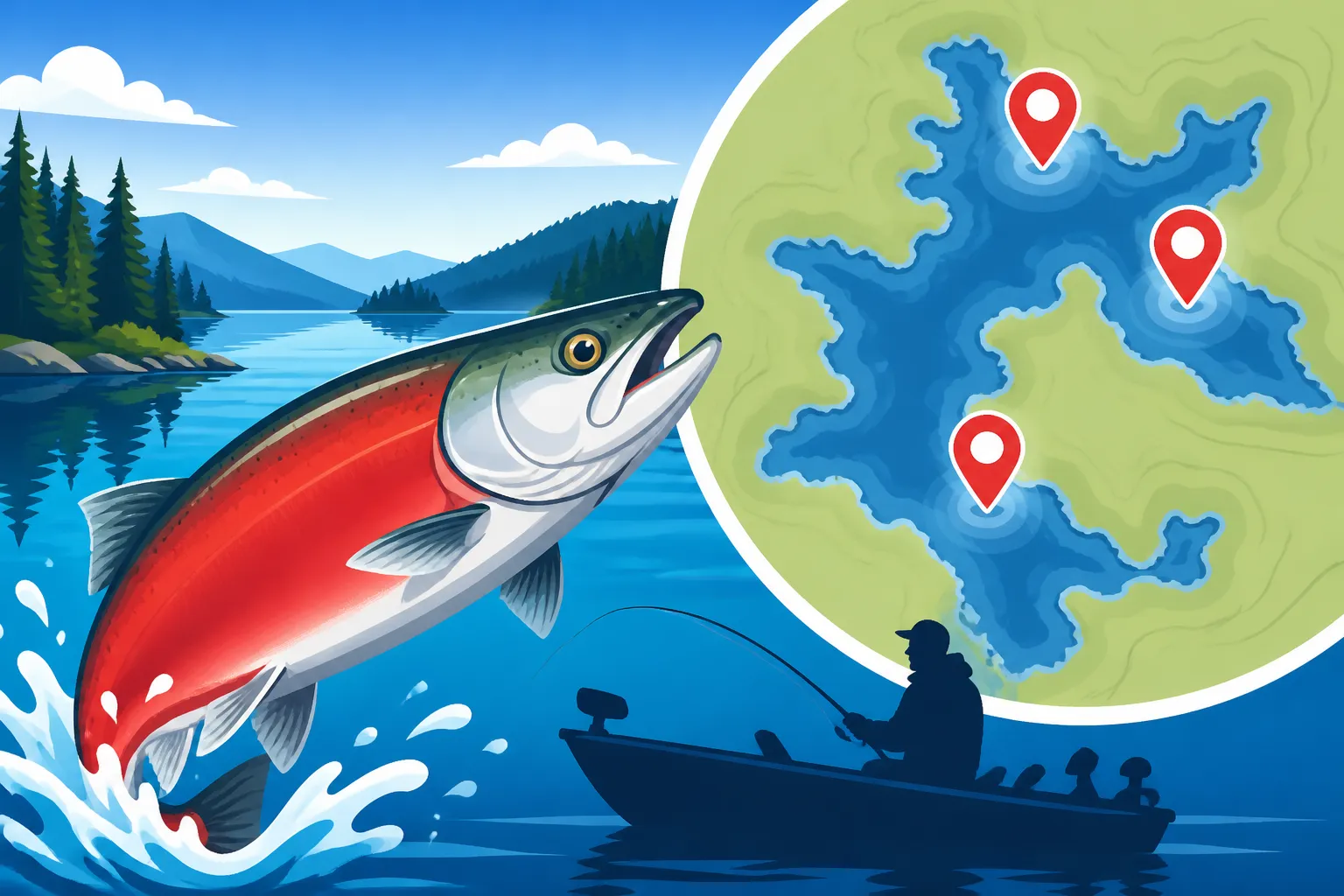
Many seasoned kokanee anglers will point you towards the southern end of Lake Coeur d'Alene. This expansive area, including bays like Blue Creek Bay, Rockford Bay, and the general vicinity south of Harrison, tends to be a major kokanee hub.
The water here is often deep, offering the thermal refuge kokanee seek, especially during the warmer months. These bays and the main lake channel running through them create a vast foraging ground. The topography is less about specific "structure" and more about broad, deep water where plankton can thrive. Anglers often find success by systematically trolling patterns in these bays, paying close attention to their fish finders. The subtle changes in depth, or "shelves" that drop off into deeper water, can sometimes act as current breaks or areas where plankton accumulates, drawing in schools of kokanee. When you're out there, remember that the sheer size of these areas means patience and methodical trolling are your best friends. These areas also hold good populations of Chinook salmon, which often feed on kokanee, so don't be surprised if you hook into a bigger predator!
Mid-Lake Open Water and Drop-offs
Don't ignore the seemingly featureless expanse of Lake Coeur d'Alene's open water. For plankton feeders like kokanee, the middle of the lake, particularly over the deepest parts and along major drop-offs, can be incredibly productive.
Think of the stretch from Blackwell Island down past Higgens Point, and further south towards Harrison in the main channel. These areas offer vast expanses of deep, cool water that become critical sanctuaries for kokanee during the heat of summer. The mid-lake open water isn't about fishing a visible spot; it's about fishing a specific depth in a wide-open area where the thermocline and plankton concentrations are just right. Pay close attention to your electronics here. You're looking for those tell-tale arches or even solid red lines indicating schools of fish. The drop-offs, where the lake bottom plunges dramatically, often create upwellings or current seams that concentrate plankton, making them natural highways for kokanee. This is where your understanding of What Depth Kokanee Hold at in Summer on Idaho Lakes becomes vital. Local insights, perhaps even from a quick chat with a guide found via FishingBooker, can confirm current productive depths and areas.
Spawning Runs in Tributary Rivers
While typically a lake fishery, it's worth noting that come late fall, kokanee will embark on their spawning migration up tributary rivers. The Coeur d'Alene River, particularly its lower stretches, and various smaller creeks feeding the lake become prime locations as the fish move upstream to reproduce.
During this time, anglers typically shift from trolling in the lake to targeting these fish in riverine environments. While the focus of this guide is catching them in the lake, it's a critical part of the kokanee life cycle that influences their presence and abundance in the main lake during other seasons. Once they enter the rivers, their behavior changes dramatically; they are no longer actively feeding but are driven by the instinct to spawn. Rules can change for these areas, so always consult the latest Idaho Fishing Regulations Explained for specific river sections during spawning periods.
Optimal Times and Conditions for Kokanee Success
Timing, as with most fishing, is everything when it comes to kokanee. Beyond just the season, the time of day and prevailing weather conditions can make a monumental difference in your success rate on Lake Coeur d'Alene.
Best Time of Day
Kokanee, like many salmonids, tend to be most active during periods of low light. This means your best bets for consistent action on Lake Coeur d'Alene are typically early morning, just as the sun is cresting the horizon, and late afternoon into early evening, as the sun dips.
During these times, the light penetration into the water is less intense, making the kokanee feel more secure and willing to move higher in the water column or become more aggressive in their feeding. As the sun climbs higher and beats down on the lake, especially in summer, kokanee will often retreat to deeper, darker water, requiring more precise depth control and presentation. However, even midday can be productive if you can accurately locate schools using your fish finder and consistently present your lures at their depth. The "golden hour" for kokanee isn't a hard and fast rule, but it certainly offers a higher probability of consistent action, often meaning you spend less time searching and more time fighting fish.
Weather and Water Temperature Considerations
Weather plays a significant role, though perhaps not in the way you might think for these deep-water dwellers. Overcast days, for instance, can sometimes prolong the "low light" conditions, making kokanee active for longer periods and sometimes even prompting them to come up shallower than they would on a bright, sunny day.
Strong winds can make trolling a challenge, but a light chop on the water's surface can actually be beneficial, breaking up light penetration and masking your boat's presence. However, the most critical environmental factor is undoubtedly water temperature, specifically the temperature at various depths. Kokanee are incredibly sensitive to temperature changes. You'll often find them congregating just above or within the thermocline – the layer of water where temperatures change rapidly. Monitoring surface water temperature is a start, but understanding the full thermal profile of the lake with a good fish finder and temperature probe is a game-changer. Sudden cold fronts can sometimes put fish down, making them less willing to bite, while stable weather patterns often lead to more predictable kokanee behavior. Keep an eye on the forecast, and don't be afraid to experiment with depths if conditions have recently shifted.
Essential Techniques and Gear for Lake Coeur d'Alene Kokanee
Catching kokanee consistently on Lake Coeur d'Alene isn't just about showing up; it's about employing the right strategies and having the proper tools. This is a game of precision, stealth, and sometimes, a little bit of flair.
Trolling Strategies and Lures
Trolling is hands down the most effective way to catch kokanee in Lake Coeur d'Alene. It allows you to cover vast amounts of water and present your lures at specific depths for extended periods. The key components of a successful trolling setup are downriggers (or at least a good lead core line setup), dodgers or flashers, and small, vibrant lures.
Downriggers are crucial, especially in summer, as they allow you to precisely position your lure at the exact depth where kokanee are holding. Without them, maintaining a consistent depth in open water is incredibly difficult. You’ll want to watch your fish finder constantly and adjust your downrigger balls to put your lure right in the strike zone. If you're new to this, there are many resources on Idaho Trolling Techniques Guide that can help you get started.
Dodgers and Flashers are an absolute must. These attractors don't just add flash and vibration; they create a distinctive pulsing action that kokanee are drawn to. Popular colors for dodgers often include silver, gold, chartreuse, pink, and orange. The size of the dodger will affect the action of your lure, so experiment to see what works best on a given day.
Lures for kokanee are generally small, ranging from 1 to 2.5 inches. Popular choices include mini hoochies, small spoons (like Dick Nites or Kokanee Kings), and spinner baits (like Wedding Rings). Color can be critical: pink, orange, chartreuse, and sometimes even red or purple are common favorites. Many anglers tip their lures with a small piece of shoepeg corn, often soaked in a scent attractant like garlic, anise, or krill. The corn adds scent, flavor, and a bit of buoyancy, which can make all the difference. For more details on specific options, check out our guide on Best Lures for Idaho Kokanee Fishing.
Electronics and Finding the Fish
In the vastness of Lake Coeur d'Alene, your fish finder is not just a luxury; it’s your most important piece of gear. Think of it as your eyes below the surface, helping you locate schools of kokanee and the depths they're holding at.
Modern fish finders, especially those with good side-scanning or down-scanning capabilities, can reveal not only individual fish but also entire schools, often appearing as "clouds" or dense arches. You’re looking for these concentrations, as kokanee are typically schooled up. Once you mark fish, pay close attention to the depth reading. This is the depth where you'll want to deploy your downriggers and present your lures. GPS functionality is also incredibly helpful. Mark productive spots or create trolling paths (waypoints and tracks) to replicate successful passes. If you find a school and catch a fish, mark that spot immediately and consider making another pass. Knowing How to Find Kokanee on a Fish Finder is a skill that dramatically improves your catch rate. Even if you're out with a guide, understanding how they interpret the screen can empower your future solo trips.
Other Gear Considerations
Beyond the core trolling setup, a few other items will enhance your kokanee fishing experience.
- Rods and Reels: Light to medium-light action rods, typically 7-9 feet long, with a fast action tip are ideal. These rods have enough backbone to handle a fighting kokanee but are sensitive enough to detect subtle bites. Pair them with small baitcasting reels or spinning reels spooled with 8-10 lb monofilament or fluorocarbon line.
- Net: A long-handled, soft-mesh net is essential. Kokanee have delicate mouths, and a good net will help you land them safely and avoid losing them boat-side.
- Cooler with Ice: Kokanee are excellent eating fish, but they spoil quickly in warm weather. Have a cooler full of ice ready to immediately chill your catch. This preserves their quality for the dinner table.
- Sun Protection: Long days on the water mean exposure to the elements. Hats, sunglasses, and sunscreen are crucial.
- Idaho Fishing License: Of course, you absolutely need a current Idaho fishing license. Make sure you have one for everyone fishing, and be aware of any specific permits, like the Idaho Salmon and Steelhead Permit, if you venture into targeting those species. You can easily purchase these online or at local tackle shops.
If you’re just starting out or visiting the area, considering a guided trip from a reputable outfitter you might find on FishingBooker can be an invaluable learning experience. They’ll have all the right gear and local knowledge to put you on fish quickly.
Remember that Idaho Catch Limits and Bag Limits Explained are always in effect, so be sure to check the latest regulations from the Idaho Department of Fish and Game. Lake Coeur d'Alene is a beautiful place to spend a day on the water, and with these tips, you're well on your way to a successful kokanee adventure!
Comparing Kokanee Depths by Season on Lake Coeur d'Alene
To help visualize where kokanee might be holding throughout the year, here's a general guide. Keep in mind these are averages, and fish behavior can vary based on specific conditions, plankton blooms, and water temperatures.
| Season | Typical Depth Range (Feet) | Preferred Water Temperature (Fahrenheit) | Primary Trolling Method | Notes |
|---|---|---|---|---|
| Spring | 10 – 40 ft | 45 – 55°F | Downriggers, Lead Core, Flatline | Fish more active, shallower; widespread in the lake. |
| Early Summer | 20 – 60 ft | 50 – 60°F | Downriggers, Lead Core | Start moving deeper as surface warms. |
| Mid-Summer | 50 – 100+ ft | 45 – 55°F (Thermocline) | Downriggers (essential) | Deepest phase, precise depth control critical. |
| Late Summer | 40 – 80 ft | 45 – 58°F (Thermocline) | Downriggers | May start to rise slightly as surface temps cool. |
| Fall | 20 – 50 ft | 40 – 55°F | Downriggers, Lead Core | More active, preparing for spawn; move towards tributaries. |
Remember, this table provides a general guideline. Always refer to your fish finder to mark actual fish and adjust your depths accordingly. Local knowledge, sometimes gained by talking to other anglers or even booking a quick trip through a service like FishingBooker, can be the most accurate real-time data you'll get.
Disclaimer
Fishing conditions and regulations in Idaho can change frequently. Always consult the latest Idaho Department of Fish and Game regulations and proclamations before heading out on the water. This guide is for informational purposes only and does not supersede official government regulations.