How Deep Lake Trout Hold in Priest Lake in Summer
There's nothing quite like the immense beauty of Priest Lake in the summer. Crystal clear waters, towering pines, and the promise of a big fish tugging on your line. But let's be honest, trying to find those elusive lake trout (often affectionately called Mackinaw here in Idaho) during the warmer months can feel like searching for a needle in a massive, deep blue haystack. Many anglers get frustrated when their usual spring and fall spots go quiet. The simple truth is, these magnificent fish don't disappear; they just move, and understanding where they go and why is the key to unlocking consistent summer success on Priest Lake. This guide is all about demystifying the deep-water habits of Priest Lake's summer Mackinaw, giving you the insights and techniques to put more of these impressive fish in your boat.
The Summer Retreat: Why Lake Trout Go Deep in Priest Lake
When summer truly kicks in, the entire ecosystem of a large, deep lake like Priest Lake undergoes a significant transformation. For cold-water species like lake trout, this means adapting to changes in water temperature, oxygen levels, and the movements of their primary food sources. They don't just randomly vanish; their retreat to the depths is a survival mechanism.
Understanding Priest Lake's Thermal Layers
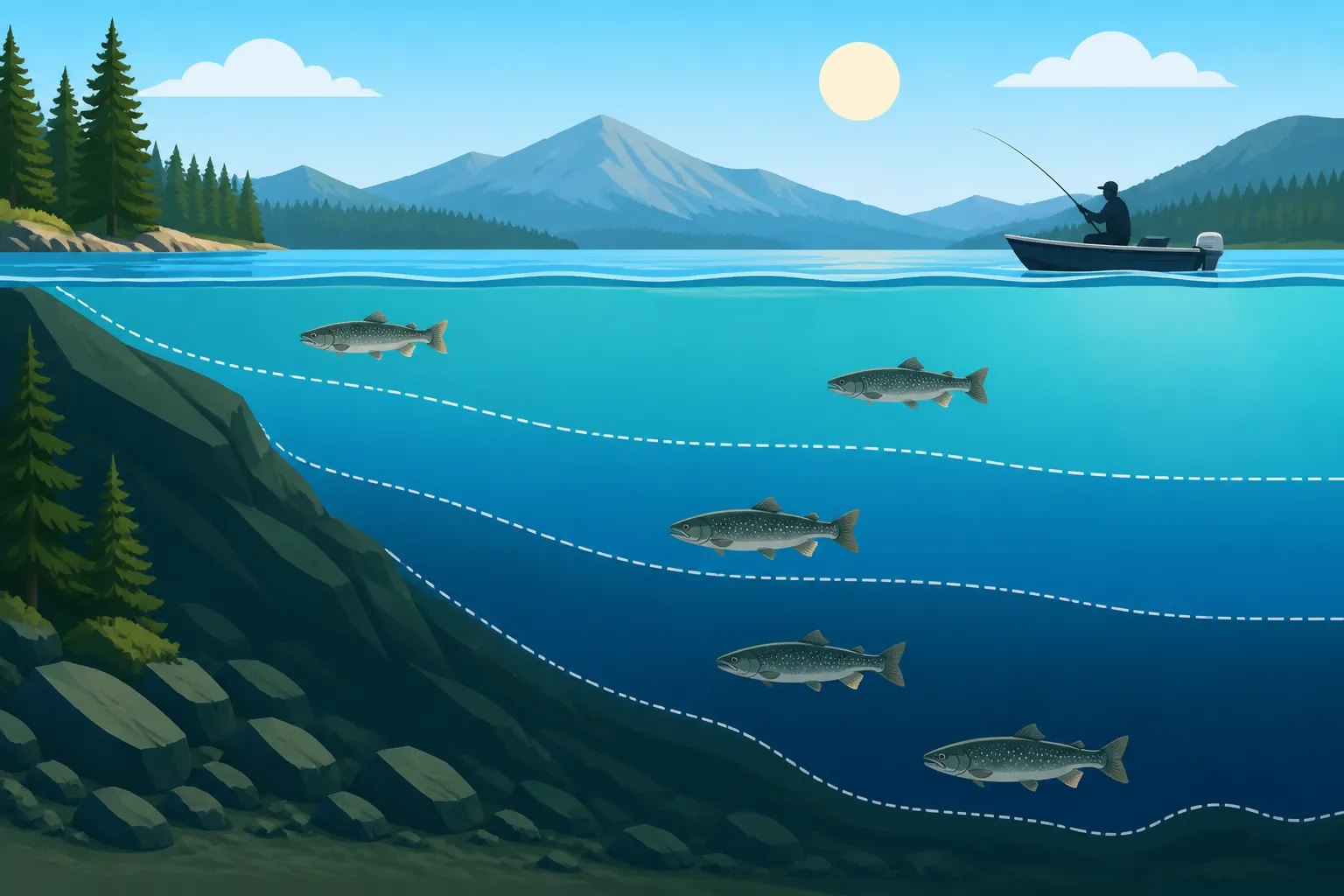
As the sun beats down on Priest Lake through June, July, and August, the surface waters begin to warm up considerably. This leads to a phenomenon known as thermal stratification, where the lake essentially divides itself into distinct temperature layers, much like a three-layered cake.
- The Epilimnion: This is the uppermost layer, warmed by the sun and mixed by wind. It's where you'll find swimmers enjoying the pleasant temperatures. For lake trout, this layer quickly becomes too warm and holds less dissolved oxygen than they prefer, especially during prolonged heat spells.
- The Metalimnion (Thermocline): Just below the epilimnion is the thermocline. This is a crucial, distinct layer where the water temperature drops rapidly over a relatively short vertical distance. Think of it as nature's invisible wall. This is often the transition zone where baitfish and, consequently, lake trout will hold. In Priest Lake, this layer can typically form anywhere from about 25 to 70 feet deep, varying with the season's progression and specific weather patterns. It's a critical zone to understand, and your sonar will become your best friend in locating it.
- The Hypolimnion: Below the thermocline lies the hypolimnion. This is the deepest, coldest, and often most oxygenated water layer. Lake trout are physiologically designed for these conditions, preferring water temperatures generally between 45-55°F (7-13°C). Once the surface waters warm, this deep, cold sanctuary becomes their primary residence. If you're looking for an extensive understanding of how fish react to water temperature, check out our guide on How Water Temperature Affects Idaho Trout Fishing.
The Pursuit of Prime Forage
It's not just about comfort; it's about dinner! Lake trout are apex predators in Priest Lake, and their diet primarily consists of smaller baitfish like kokanee salmon and whitefish. These forage fish are also sensitive to water temperature and light levels. As the surface water warms and light penetrates deeper into the clear waters of Priest Lake, kokanee and whitefish will also move into cooler, deeper water to find their preferred temperatures and to avoid predators from above.
Naturally, where the food goes, the predators follow. So, while you're hunting for deep lake trout, you're often also implicitly searching for schools of baitfish. Locating these baitfish schools on your fish finder will give you a major clue as to where the Mackinaw are likely holding, staging for an ambush. It’s a classic predator-prey relationship playing out in the deep, dark corners of the lake.
Pinpointing the Depths: Where Mackinaw Live in Priest Lake's Summer Waters
Understanding why they go deep is one thing, but knowing exactly where to drop your lines is the real challenge. Lake trout in Priest Lake during summer don't just roam aimlessly in the abyss; they relate to specific features and layers.
The Thermocline as Your Target Zone
While it's easy to say "fish deep," the key is often to fish within or just below the thermocline. This invisible temperature boundary creates a comfortable band of water that offers the ideal combination of cold water and ample oxygen. As mentioned, this thermocline typically sets up somewhere between 40 to 80 feet, but it can absolutely vary. On a cloudy, cooler day, fish might push a little shallower. On a scorching, sunny day, they might be pushed even deeper.
Experienced anglers targeting Priest Lake's trophy lake trout often focus their efforts in this zone. You'll want to pay close attention to your boat's electronics to identify this layer. It usually shows up as a distinct band on your sonar where the temperature changes rapidly. This is where you'll often see baitfish schools stacked up, and where the Mackinaw will be cruising, looking for an easy meal. Remember, fishing "on" the fish is always better than fishing "where the fish should be."
Relating to Submerged Structure
Even in deep water, structure is king. Lake trout, like many predatory fish, use underwater features for ambush points, cover, and as navigation highways. Priest Lake is known for its incredible underwater topography, including deep ledges, shelves, humps, and old river channels from when the lake was formed.
When you're searching for deep-holding Mackinaw, don't just focus on open water. Target areas where these deep structures intersect with the thermocline. For example, a submerged hump that rises from 150 feet to 70 feet would be a prime target. The sides and top of that hump, especially where it meets the cooler water, will concentrate baitfish, and thus, lake trout. These areas offer distinct advantages:
- Ambush Points: Lake trout can hide along ledges or near humps, darting out to strike at unsuspecting baitfish.
- Concentration: Structure tends to aggregate baitfish, creating more consistent feeding opportunities for the Mackinaw.
- Thermal Breaks: Sometimes, deeper structures can create micro-currents or upwellings that bring slightly cooler, oxygenated water to specific points, making them even more attractive to trout.
Spending time studying nautical charts of Priest Lake and using your sonar to map out these submerged features will pay dividends. Many anglers will key into specific "honey holes" – deep points or submerged islands that consistently hold fish year after year. For more information on where these fish typically thrive, our guide on Priest Lake's Trophy Lake Trout Fishing Grounds offers excellent insights.
Strategies for Success: Effective Techniques for Targeting Deep Lake Trout
Getting your lure down to 60, 80, or even 100 feet in a large lake like Priest Lake requires specialized techniques and equipment. You can't just cast out a spoon and hope for the best. Precision and persistence are your allies here. When you're thinking about Idaho Fishing Techniques Guide, deep trolling and jigging are paramount for summer Mackinaw.
Mastering Downriggers and Dipsy Divers
These are arguably the most effective tools for consistent summer lake trout fishing on Priest Lake. They allow you to present your lures at incredibly precise depths, right where the fish are holding.
- Downriggers: These are mechanical devices that use a heavy cannonball weight to pull your fishing line down to a specific depth. Your lure trails behind the cannonball, attached to your main line via a release clip. When a fish strikes, the line pops free from the clip, and you fight the fish directly, without the weight of the cannonball. For example, if your sonar shows fish consistently at 70 feet, you can set your downrigger to 70 feet and know your lure is right in the strike zone. You can often run multiple downriggers off the back of your boat, spreading out your lure presentations.
- Dipsy Divers (or Planer Boards with Diving Weights): These are alternative or supplementary tools. Dipsy divers use water pressure to dive, and they also pull your line out to the side of the boat, helping you cover a wider swath of water and keep your lines from tangling. They come in various sizes and settings to achieve different depths and lateral spreads. While perhaps not as precise as downriggers for exact depth, they are highly effective for targeting specific zones and are often easier to set up for smaller boats.
When using either, remember that trolling speed is critical. A speed of 1.5 to 2.5 mph is often a good starting point for lake trout, but experiment. Different lures have different actions at various speeds, and the fish might prefer a faster or slower presentation on any given day. Your electronics will show you your speed over ground and sometimes even your speed through the water, which can differ due to currents.
Vertical Jigging and Dropping
While trolling covers water, vertical jigging is fantastic for pinpointing fish holding tight to structure or when you've marked a school on your sonar.
- Locating Fish: Use your fish finder to identify specific fish or schools of fish around deep humps, ledges, or drop-offs.
- Positioning: Maneuver your boat directly over these fish using your trolling motor or by drifting. Precision is key.
- Presentation: Drop a heavy jig (often 1-3 ounces or more, depending on depth and current) or a large soft plastic swimbait straight down to the fish's depth. The key is to get it to them quickly.
- Action: Once at depth, use an aggressive jigging motion – a sharp lift of the rod tip followed by a controlled fall, allowing the lure to flutter and entice a strike. Lake trout can be incredibly aggressive when jigged vertically, often inhaling the lure on the fall.
This technique is especially effective for cleaning up after a trolling pass if you’ve marked fish that didn’t commit, or for targeting specific, isolated structures that are too small to troll effectively.
The Indispensable Role of Sonar and GPS
Modern marine electronics are not just helpful; they are absolutely essential for summer lake trout fishing on Priest Lake. Trying to find deep fish without a quality fish finder is like trying to find a specific house in a big city without a map.
- Sonar (Fish Finder): This is your window to the underwater world. You'll use it to:
- Locate the Thermocline: Identify that distinct temperature change layer.
- Mark Baitfish Schools: Look for dense clouds or arches, indicating where the lake trout's food is concentrated.
- Identify Lake Trout: Large, distinct arches or "blobs" on the screen are your targets. Often, you'll see them lurking just below baitfish schools.
- Map Structure: See submerged humps, drop-offs, and old creek beds.
- GPS (Global Positioning System): Once you find a productive area, your GPS allows you to:
- Mark Waypoints: Save the exact coordinates of where you caught fish or found good structure.
- Track Trolling Passes: Replicate successful trolling patterns over the same productive ground.
- Navigate: Safely get back to your spots, especially on a large lake like Priest Lake.
Look for units with high-resolution screens and features like side-imaging or down-imaging, which provide incredibly detailed views of the bottom and structure. Brands like Humminbird and Lowrance offer excellent options that can make a huge difference in your success rate. Without good electronics, you're truly just guessing.
Equipping Your Adventure: Gear Essentials for Priest Lake's Deep Waters
You're heading into battle with some of the lake's biggest, hardest-fighting fish. You need the right tools for the job. Don't skimp on gear when targeting Priest Lake's deep-water Mackinaw.
Rods, Reels, and Line for the Deep Battle
Your standard trout spinning setup just won't cut it for deep-water trolling or heavy jigging for lake trout.
- Rods: Look for stout, medium-heavy to heavy action trolling rods, typically 7 to 9 feet in length. These rods need enough backbone to handle heavy downrigger weights or jigs, absorb the shock of a big lake trout strike, and stay loaded in a rod holder while trolling. They should have a moderate tip action to detect subtle bites but plenty of power in the butt section.
- Reels: Line counter reels are almost a necessity for deep trolling. These conventional reels feature a counter that tells you exactly how much line you have out, allowing you to replicate successful depths with precision. Look for models with strong drags and high line capacity. Many reputable brands offer excellent line counter reels, and you can find a great selection of high-quality options on Amazon.
- Line: For downrigging, a low-stretch braided line in the 30-50 lb test range is ideal as your main line. Braid offers superior sensitivity, allowing you to feel even the slightest tap, and its lack of stretch means better hooksets at depth. Attach a fluorocarbon leader (15-25 lb test, 6-15 feet long) to your braid via a strong knot like an Albright or blood knot. Fluorocarbon is nearly invisible underwater, which can be critical in Priest Lake's clear waters, and offers good abrasion resistance against a Mackinaw's sandpaper-like mouth. For jigging, braid as a main line with a fluorocarbon leader is also an excellent choice.
Lure Selection for Mackinaw
Lake trout are opportunistic predators, but certain lures consistently perform well in Priest Lake's deep summer waters. Our Best Lures for Idaho Trout Fishing guide has more detailed information, but here are some specific recommendations for Mackinaw:
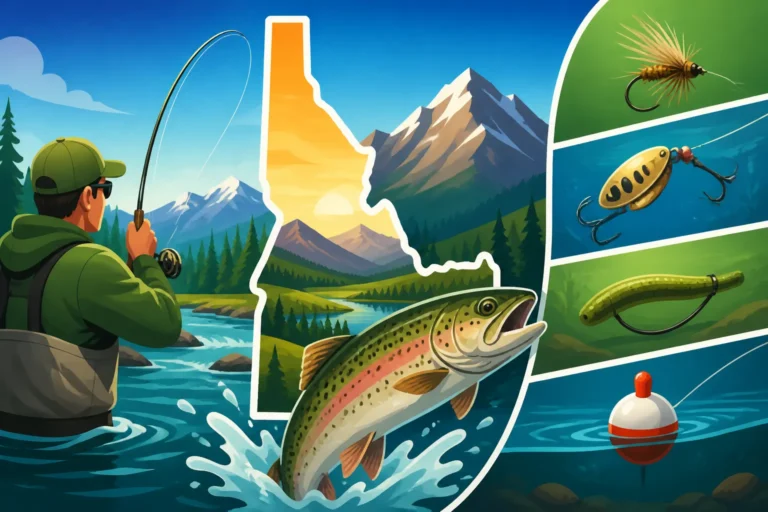
- Spoons: Large trolling spoons are classics for a reason. Colors like silver, chartreuse, blue/silver, and watermelon often produce. Consider brands like Luhr Jensen, Silver Horde, or Pro-Troll. Sizes typically range from 3 to 6 inches. The fluttering action of a spoon mimics an injured baitfish, making it irresistible.
- Dodgers and Flies: A dodger-and-fly (or dodger-and-squid) combination is incredibly effective, particularly when targeting kokanee-feeding lake trout. The dodger creates an erratic, attracting action, while the small fly or squid trailer (often scented) provides the actual target. Colors like white, chartreuse, pink, and glow are popular.
- Large Tube Jigs: For vertical jigging, heavy tube jigs (3-6 inches) in white, black, or natural baitfish colors are deadly. You can tip them with a piece of cut bait for added scent.
- Swimbaits: Large soft plastic paddle-tail swimbaits on heavy jig heads (1-2 oz) can also be very effective when jigging or casting to schooling fish.
Remember to experiment with colors and sizes. What works one day might not work the next. It's always a good idea to have a variety on hand. Many anglers stock up on their favorite spoons and dodgers from retailers like Amazon before their trip.
Essential Accessories and Safety Gear
Beyond your primary fishing setup, a few key accessories will make your deep-water lake trout trip safer and more enjoyable.
- Heavy Duty Net: A large, sturdy landing net with a long handle is crucial for netting big Mackinaw, especially when they come up deep and are still full of fight.
- Release Tools: Long-nose pliers or a hook remover are essential for safely unhooking fish, especially if you plan on practicing catch and release. Many Idaho Fishing Regulations Explained sections encourage safe release practices.
- Gloves: Fishing gloves can protect your hands from sharp fins, hooks, and line burn.
- Cooler and Ice: For keeping your catch fresh. Remember to review Idaho Catch Limits and Bag Limits Explained before you head out.
- Weather Appropriate Clothing: Priest Lake weather can change quickly, even in summer. Layers are always a good idea. Don't forget sunscreen, a hat, and polarized sunglasses to cut glare and help spot potential signs of activity.
- Personal Flotation Devices (PFDs): Safety first! Always ensure you and all passengers have easily accessible PFDs.
- Emergency Kit: Flares, first-aid kit, whistle, and a fully charged cell phone.
- Downrigger Weights and Release Clips: You'll need extra cannonball weights in case one gets snagged, and spare release clips are always a good idea. You can often find these specialized items at local tackle shops or easily order them from Amazon for convenience.
Equipping yourself properly for your summer Mackinaw adventure on Priest Lake will not only increase your chances of success but also ensure you have a safe and comfortable day on the water. These are formidable fish in a magnificent lake, and they demand a bit of respect, both in terms of your angling approach and your preparation. Good luck out there!
Recommended Depths and Techniques for Priest Lake Mackinaw in Summer
To help you get started, here's a table summarizing general guidelines for targeting lake trout in Priest Lake during the summer months. Remember, these are starting points, and flexibility based on your electronics and conditions is key!
| Time of Summer | Water Temperature (Surface) | Estimated Thermocline Depth | Recommended Trolling Depths | Primary Techniques | Notes |
|---|---|---|---|---|---|
| Early Summer (June) | 60-68°F (15-20°C) | 30-50 feet | 40-70 feet | Downrigging, Dipsy Divers | Fish may be slightly shallower in early mornings/late evenings. Look for active bait. |
| Mid-Summer (July-Aug) | 68-75°F+ (20-24°C+) | 50-80 feet | 60-100+ feet | Downrigging (precise), Vertical Jigging | Deepest fishing, focus heavily on structure and sonar marks. Sunnier days push fish deeper. |
| Late Summer (Sept) | 60-70°F (15-21°C) | 40-70 feet | 50-90 feet | Downrigging, Vertical Jigging | Fish may start to spread out a bit more as surface temperatures begin to cool slightly, but still deep. |
Important Considerations:
- Time of Day: Early morning and late evening often see fish moving slightly shallower (though still deep relative to spring/fall) or becoming more active. Mid-day often requires the deepest presentations.
- Weather: Overcast days might keep fish higher in the water column than bright, sunny days.
- Baitfish: Always look for baitfish on your sonar. The Mackinaw won't be far away!
- Currents: Strong winds can create subtle currents even in deep water, affecting your lure's action and presenting a challenge for boat control during jigging.
Good luck on the water, and tight lines!
Disclaimer
Fishing conditions and regulations in Idaho can change. Always consult the latest Idaho Fish and Game regulations brochure before heading out on the water. This guide is for informational purposes only and does not supersede official regulations.